Drawing With No Pictures
 Drawing With No Pictures
Contents
There is no artist on this project. There is also no assets/ folder, no sprite sheet, no .png anywhere the game will ever load. And yet the thing has a look — neon shapes smeared with bloom, a curved CRT with scanlines and a slight colour fringe at the edges, invaders that squash when they die. The invaders find this deeply unfair. They were promised a rendering department. The rendering department was, and I quote the game’s own modifier text, “laid off.”
This part is about how you build an arcade with no images. Two layers do all the work: a software glow pass drawn from raylib primitives, and a GPU post-processing chain — bloom plus a CRT composite — compiled from GLSL strings baked into the binary. No file the game reads is larger than the source that draws it.
It is also about a bug. The screenshots taken for this series show that the bloom has been upside down since the day it was written, in every frame the game has ever drawn. The last section shows where that comes from and the one line that fixes it.
This is Part 2 of six on the engineering behind SPACE INVADERS: WE HAVE DEMANDS; Part 1 is the tour. Code is quoted from the game at 25bd61d, as throughout the series.
The look is a lie you draw three times
Start with the cheapest trick in the file. There are no glowing shapes in raylib. So we fake a glow the way a stage lighting rig does — draw the same shape more than once, big and faint underneath, small and solid on top:
void GlowRect(Rectangle r, Color c) {
    float g = cfg::kGlowHalo;                                   // 6 px
    DrawRectangleRec({r.x - g, r.y - g, r.width + 2*g, r.height + 2*g},
                     WithAlpha(c, cfg::kGlowHaloA));            // 0.12 — big, faint
    DrawRectangleRec({r.x - 2, r.y - 2, r.width + 4, r.height + 4},
                     WithAlpha(c, cfg::kGlowMidA));             // 0.28 — mid
    DrawRectangleRec(r, c);                                     // solid core
}
That’s the whole idea: an outer halo at 12% alpha, a mid ring at 28%, then the crisp core. GlowCircle, GlowLine, and GlowText are the same pattern in different primitives — GlowText is literally the string drawn twice, once offset and dimmed as a drop-shadow, once sharp on top. Every neon edge in the game is two or three overlapping translucent draws, and the numbers all live in config.h (kGlowHalo, kGlowHaloA, kGlowMidA, …) because typing a literal into a draw call is, per house rule, grounds for a staff meeting.
This is doing a real job. The glow pass is what feeds the bloom shader later — it lays down soft, bright margins around every shape so the GPU pass has something to bleed. The two layers are designed together: cheap CPU halos to shape the light, then a GPU blur to make it convincing.
Invaders are 48 bits and a mood
There are no invader sprites either. Each archetype is a pair of 8×6 bitmasks — one per march frame — and the silhouette is drawn one lit cell at a time:
// Row archetypes: 0 = squid (executive), 1-2 = crab (manager), 3-4 = octopus (intern).
constexpr uint8_t kSquid[2][6] = {
    {0b00011000, 0b00111100, 0b01111110, 0b11011011, 0b00100100, 0b01011010},
    {0b00011000, 0b00111100, 0b01111110, 0b11011011, 0b01011010, 0b10100101},
};
Six bytes, two frames, three archetypes — that’s the entire cast’s art, and you can read the aliens right there in the binary literals. The draw loop walks the bits and does a little extra work per cell to sell depth on a flat shape:
for (int r = 0; r < 6; r++) {
    // vertical shading: bright top, deeper bottom (reads as a lit dome)
    Color rc = ShadeColor(tint, 1.20f - 0.45f * (r / 5.0f));
    for (int b = 0; b < 8; b++) {
        if (!(mask[frame][r] & (1 << (7 - b)))) continue;
        float jx = 0, jy = 0;
        if (wobbly) {                                  // "The Understudies" modifier
            jx = WobbleOff(seed + r*8 + b, time, 6.0f, 1.6f);
            jy = WobbleOff(seed + r*8 + b + 999, time, 5.0f, 1.6f);
        }
        DrawRectangleRec({x0 + b*cw + jx, y0 + r*ch + jy, cw + 0.5f, ch + 0.5f}, rc);
    }
}
Three details worth calling out, because each is a design rule from Part 1 showing up in pixels:
- Per-row shading.
ShadeColor(tint, 1.20 → 0.75)brightens the top rows and darkens the bottom, so a flat cell grid reads as a lit dome. No normals, no lighting — just a scalar ramped down the mask. - The wobble is a modifier, not a decoration. When “The Understudies” is active,
wobblyis true and every cell gets a per-cell hash-driven jitter (WobbleOffis a deterministicsinof a hashed seed — no RNG state, consistent with the no-statics rule). The joke is that the understudies can’t hold still; the mechanical consequence is that the drawn silhouette drifts, so the hitbox you’re aiming at isn’t quite where the body is. Every gag changes play. - Squash and stretch come in as
sx/syscale factors, so a dying invader can flatten without a second art asset.
The player ship, the UFO, and every projectile are the same story — procedural vector shapes assembled from triangles, ellipses, and glowing rects (DrawPlayerArt, DrawUfoArt, DrawShotArt in render.cpp). The player even has a flickering thruster flame computed from sin(time * 40). It’s all maths. None of it is loaded.
The bloom is real, and it runs on the GPU
The software glow gives us bright margins. The convincing part — the light that bleeds past its edges — is a proper multi-pass bloom on the GPU, and it lives entirely in postfx.cpp. There are no .fs/.vs files; the three shaders are constexpr const char* GLSL 3.3 strings compiled with LoadShaderFromMemory, so the whole effect ships inside the executable.
Pass 1 — bright-pass extract. Sample the scene, compute luminance, and keep only the pixels above a threshold, with a soft knee so the cutoff isn’t a hard edge:
vec3 c = texture(texture0, fragTexCoord).rgb;
float l = dot(c, vec3(0.2126, 0.7152, 0.0722));       // Rec. 709 luma
float w = smoothstep(threshold - knee, threshold + knee, l);
finalColor = vec4(c * w, 1.0);
This renders into a downscaled target (canvas / kBloomDownscale, i.e. half res) — cheaper to blur, and the blur hides the downsampling. The threshold is 0.66 and the knee 0.28, so a pixel starts to count at a luma of 0.38 and counts in full from 0.94.
Pass 2 — separable Gaussian blur. A 9-tap Gaussian, run as a horizontal pass then a vertical pass, ping-ponged between two textures for several iterations:
Texture2D src = fx.bright.texture;
int dstIdx = 0;
for (int i = 0; i < cfg::kBloomPasses * 2; i++) {         // 4 passes = 8 blits (H+V each)
    Vector2 dir = (i & 1) ? Vector2{0,1} : Vector2{1,0};
    BeginTextureMode(fx.pingpong[dstIdx]);
    BeginShaderMode(fx.blurShader);
    SetShaderValue(fx.blurShader, fx.locBlurDir, &dir, SHADER_UNIFORM_VEC2);
    SetShaderValue(fx.blurShader, fx.locBlurRes, &res, SHADER_UNIFORM_VEC2);
    BlitFill(src, fx.bw, fx.bh);
    EndShaderMode();
    EndTextureMode();
    src = fx.pingpong[dstIdx].texture;
    dstIdx ^= 1;
}
fx.finalBloom = src;
Separable is the classic win: a 2D Gaussian factored into two 1D passes is O(n) taps instead of O(n²). Four H+V iterations over a half-res buffer widen the glow a lot for very little bandwidth. finalBloom is just whichever ping-pong texture we landed on.
Pass 3 — the CRT composite. One fragment shader combines the scene with the blurred bloom and does everything that makes it feel like a tube:
vec2 uv = vec2(fragTexCoord.x, 1.0 - fragTexCoord.y);  // render targets are bottom-up
uv = barrelDistort(uv, barrel);                        // bulge the glass
if (uv.x < 0.0 || uv.x > 1.0 || uv.y < 0.0 || uv.y > 1.0) {
    finalColor = vec4(0,0,0,1); return;                // black the warped-off corners
}
vec2 dir = uv - 0.5;
vec3 scene;
scene.r = texture(texture0, uv + dir * aberration).r;  // chromatic aberration:
scene.g = texture(texture0, uv).g;                     //   split R/B radially
scene.b = texture(texture0, uv - dir * aberration).b;
vec3 col = scene + texture(bloomTex, uv).rgb * bloomIntensity;   // additive bloom
if (scanOn > 0.5) {
    float sl = 0.5 + 0.5 * sin(uv.y * scanCount * 3.14159265);
    col *= 1.0 - scanDepth * sl;                        // scanline banding
}
float vig = smoothstep(0.9, 0.15, dot(dir, dir) * 2.0);
col *= mix(1.0, vig, vignette);                         // darken the edges
finalColor = vec4(col, 1.0) * colDiffuse;
Barrel distortion bulges the image so the “glass” is convex (and the corners that get pushed off-screen are painted black, not smeared). Chromatic aberration offsets the red and blue channels radially — zero at the centre, worst at the edges, exactly like a cheap lens. Scanlines are a sin band whose count (340) and depth (0.10) are, of course, config constants. A vignette drops the corners. Every parameter is uniform-driven from config.h, so the entire CRT personality is tunable without recompiling a shader.
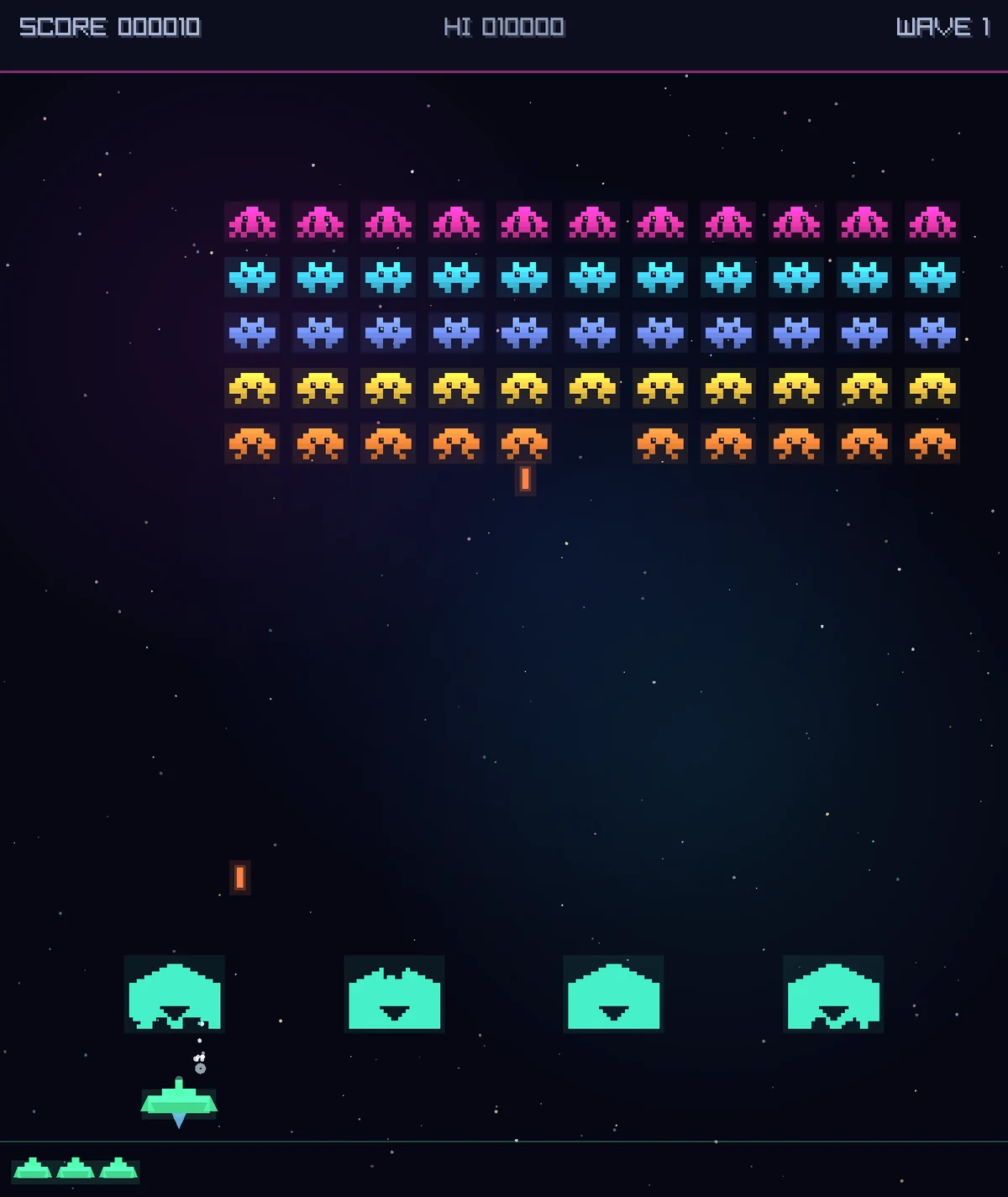
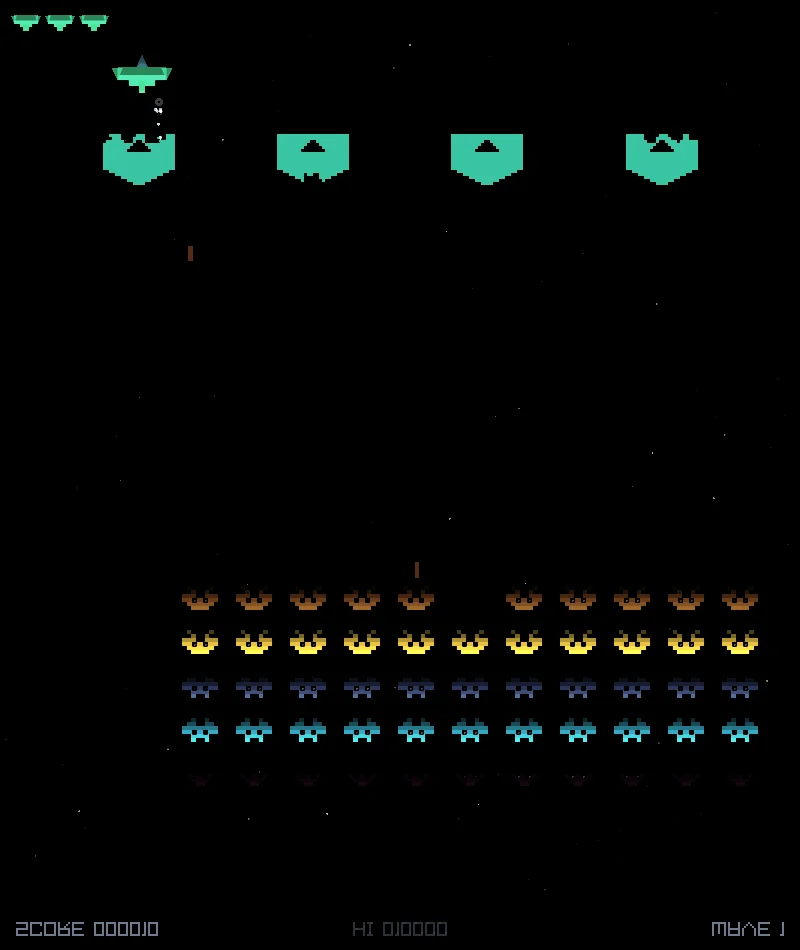
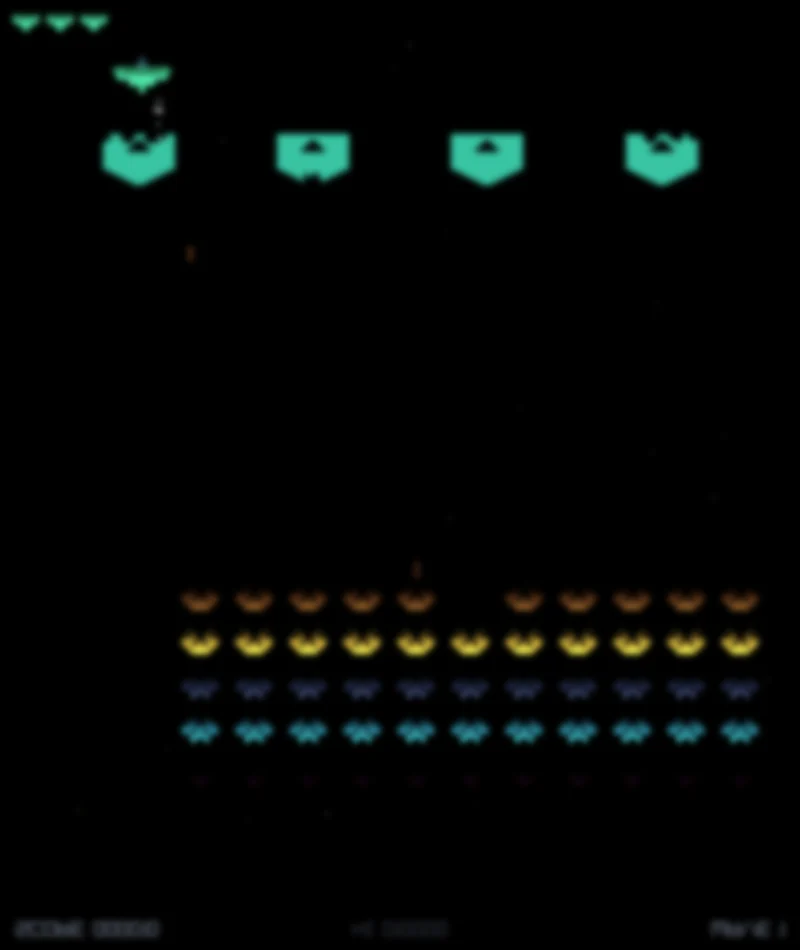
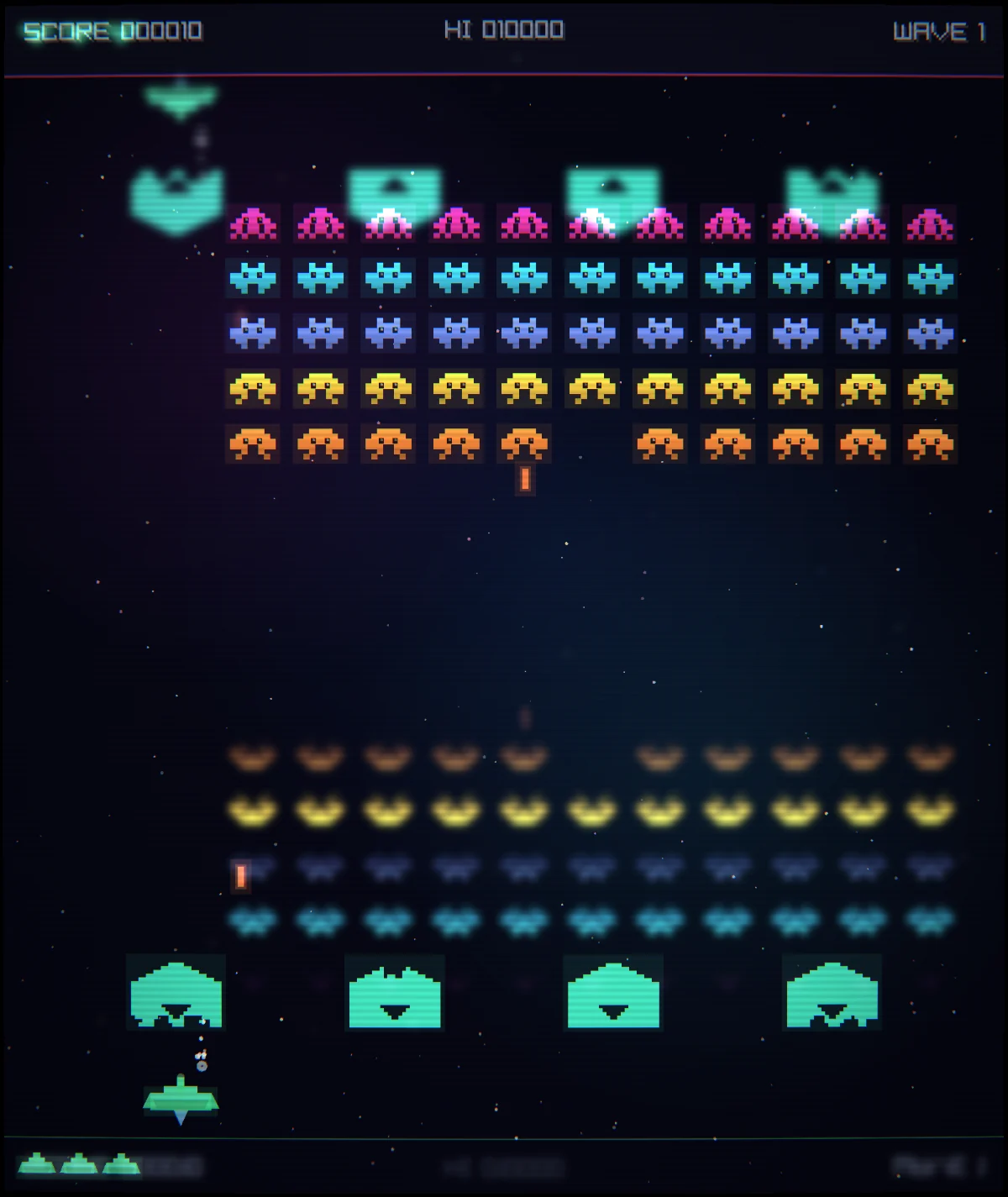
Here is one frame at every stage. The harness that took these screenshots copies the three textures out just before the composite runs, so each panel is exactly what the next pass reads:
The bloom is tuned around the content, not the other way around
Here’s the detail I like most, because it’s where art direction becomes an engineering constraint. Bloom eats bright pixels. That is great for lasers and terrible for anything you need to read — a HUD, a score, a speech bubble. So the game arranges for readable things to sit below the bloom threshold.
The HUD colour is chosen deliberately dim, with the reason written into config.h:
inline constexpr Color kColHud = {170, 185, 215, 255}; // kept below bloom threshold
The comment is wrong, and panel 2 above shows it. Put that colour through the bright-pass shader’s own formula and its luma is 0.2126 × 170/255 + 0.7152 × 185/255 + 0.0722 × 215/255 = 0.72, above the 0.66 threshold; the soft knee lets 66% of a pixel that bright through. The score and the wave counter are there in the bright pass, mirrored along the bottom. What keeps them readable is that their strokes are thin: averaged down to half resolution and blurred four times, they add a faint haze rather than a smear. A colour that really sat below the knee’s lower edge would need a luma under 0.38.
And speech bubbles — white panels, the single most bloom-prone thing on screen — are drawn after the bright-pass has already sampled the scene, by re-entering the canvas between the bloom render and the final composite:
if (postfx.enabled) RenderBloom(postfx, canvas.texture);

// speech bubbles draw AFTER the bright-pass: their white panels must not bloom
if (screen == Screen::Playing || screen == Screen::Paused || screen == Screen::GameOver) {
    BeginTextureMode(canvas);
    BeginMode2D(ssCam);
    DrawSpeechBubbles(g);
    EndMode2D();
    EndTextureMode();
}
The bright-pass never sees the bubbles, so they can’t glow into an unreadable smear — but they still land on the scene texture the composite samples, so they do get the barrel warp and scanlines like everything else. Draw order is being used as a cheap per-object bloom mask. This is the design doc’s rule for the comedy, “Jokes never interfere with play,” enforced at the framebuffer level: the invaders’ complaints are legible precisely because we refused to let them bloom.
The whole thing is allowed to fail
None of this is load-bearing for the game running. Shaders are the one place where a target machine can genuinely say no — an old driver, a headless context, a GL profile that won’t compile #version 330. So the post-FX is written to fail soft. InitPostFx validates every compile and, on any failure, flips a single flag:
bool ShaderOk(Shader s) { return s.id != 0 && s.id != rlGetShaderIdDefault(); }
// ...
if (!ShaderOk(fx.brightShader) || !ShaderOk(fx.blurShader) ||
    !ShaderOk(fx.compositeShader)) {
    fx.enabled = false;
    return;
}
ShaderOk is the important bit: raylib doesn’t throw on a failed compile, it hands back its default shader, so “did this compile” means “is the id neither zero nor the default id.” If any of the three fails, enabled stays false and the main loop takes the other branch — a plain textured blit, no bloom, no CRT:
if (postfx.enabled) {
    DrawComposite(postfx, canvas.texture, dst, cfg::kScanlines);
} else {
    DrawTexturePro(canvas.texture,
                   {0, 0, (float)canvas.texture.width, -(float)canvas.texture.height},
                   dst, {0, 0}, 0.0f, WHITE);   // negative height flips Y in the blit
}
The game looks flatter, but it runs, everywhere, with zero configuration. (Note the negative source height — the fallback has to flip the bottom-up render texture itself, the job the composite shader’s 1.0 - uv.y does on the fast path.) One flag, two draw paths, no crash surface. That is the whole graphics-driver support matrix.
The bloom is upside down
That parenthesis about flipping is where the bug lives. Look again at the screenshots in Part 1: the title glows faintly upside down beneath the menu, the green bunkers’ glow sits on the top row of invaders, and the game-over screen has a second, inverted GAME OVER beneath the first. None of that is a CRT effect. It is the bloom of the whole frame, drawn mirrored top to bottom.
The cause is a rule of raylib on OpenGL, and the code quoted above already knows it. raylib draws in screen coordinates, with y pointing down. OpenGL stores a texture’s rows from the bottom up. So when a render texture is drawn back out with a positive source rectangle, its image comes out upside down. That is why the fallback blit passes a negative height, and why the composite flips uv. And it applies to every pass of the bloom, because each one draws one render texture into another with BlitFill:
// draw a source texture to fill the current render target, no vertical flip
void BlitFill(Texture2D src, int dstW, int dstH) {
    DrawTexturePro(src, {0, 0, (float)src.width, (float)src.height},
                   {0, 0, (float)dstW, (float)dstH}, {0, 0}, 0.0f, WHITE);
}
The comment describes the call, which asks for no flip, but not the result: each BlitFill into a render texture turns the image over once. Count them. The bright pass is one. The blur is kBloomPasses * 2 = 8, an even number, so the blur leaves the orientation as the bright pass set it. That makes nine in all, so finalBloom ends up upside down relative to the canvas. The composite then reads the scene and the bloom at the same uv, flips that uv once for both, and lays the bloom over the scene mirrored. The panels above show it directly: the canvas and the two bloom textures were read back the same way, and only the canvas is the right way up.
It is easy to miss because bloom is soft. A glow in the wrong place reads as atmosphere, and in this game the brightest things sit in two bands near the top and the bottom of the screen, the grid and the bunkers, so each one’s mirrored glow lands roughly on the other.
The fix is one more flip, anywhere in the chain. The simplest place is the bright pass, which can read the canvas with a negative height the way the fallback blit does (diff):
// RenderBloom, the bright pass: was BlitFill(scene, fx.bw, fx.bh);
DrawTexturePro(scene, {0, 0, (float)scene.width, -(float)scene.height},
               {0, 0, (float)fx.bw, (float)fx.bh}, {0, 0}, 0.0f, WHITE);
The blur’s eight passes are an even number for any value of kBloomPasses, so this keeps working however the blur is tuned. Here is the same game built with that one change, next to the game as it ships:
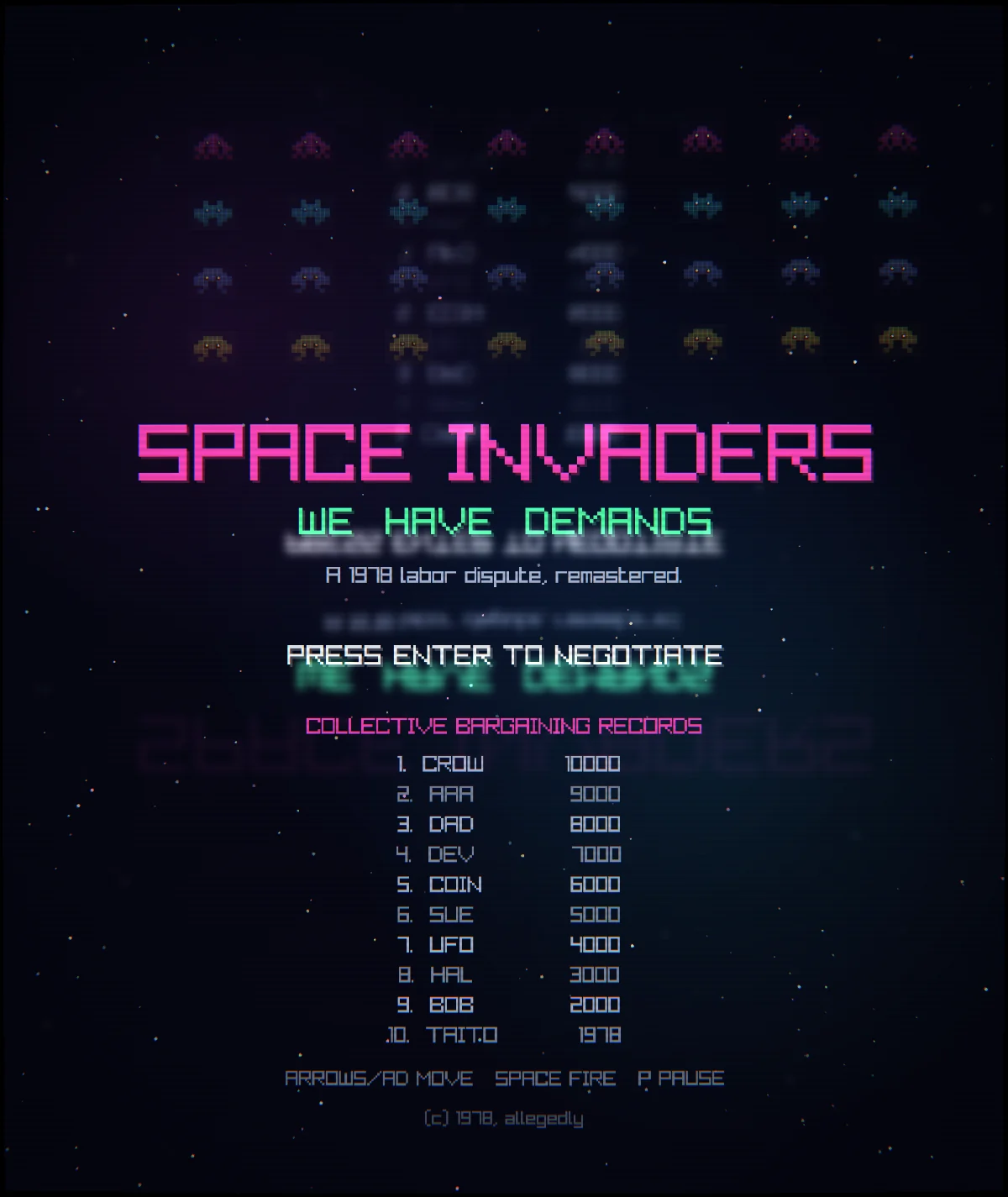
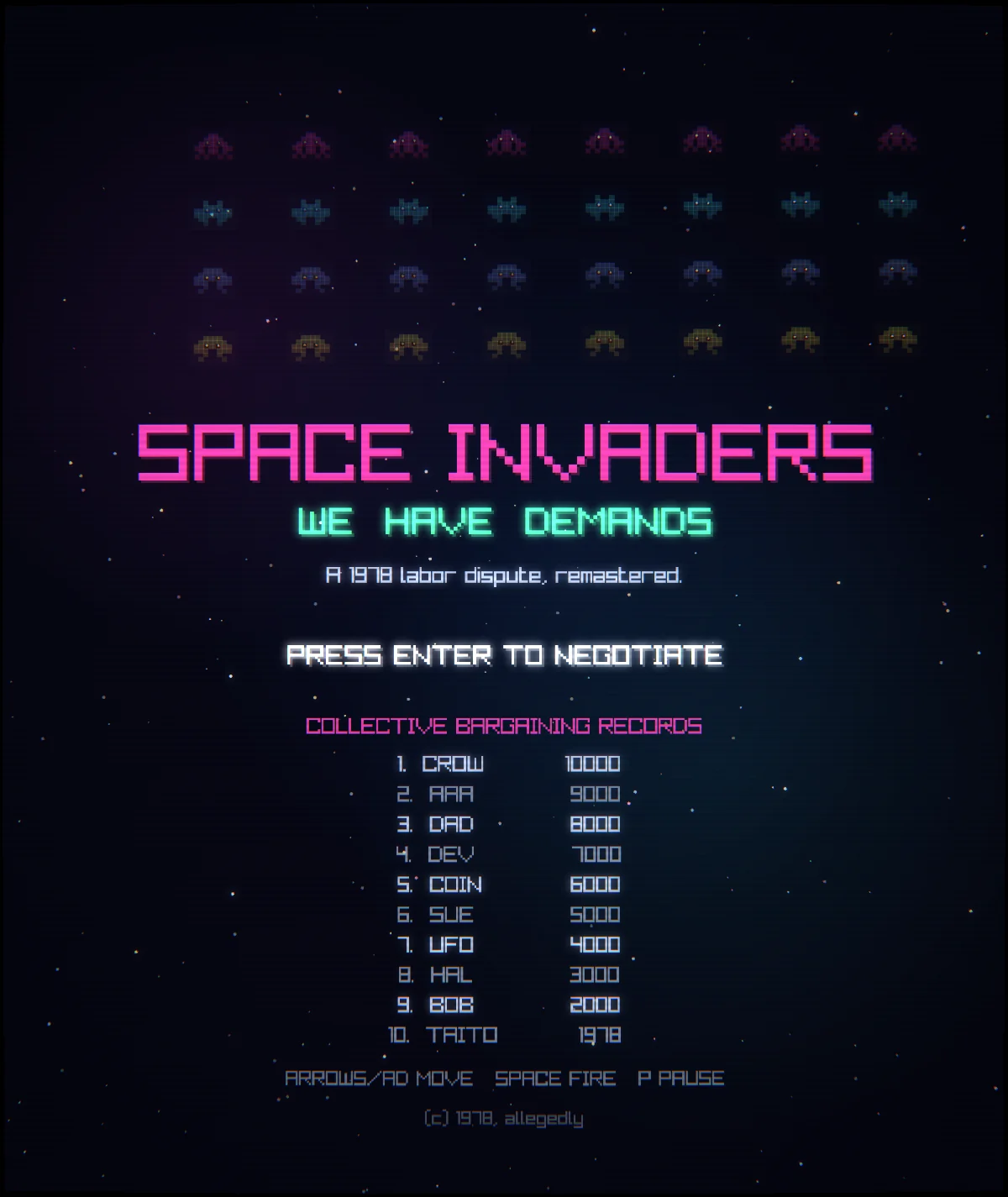
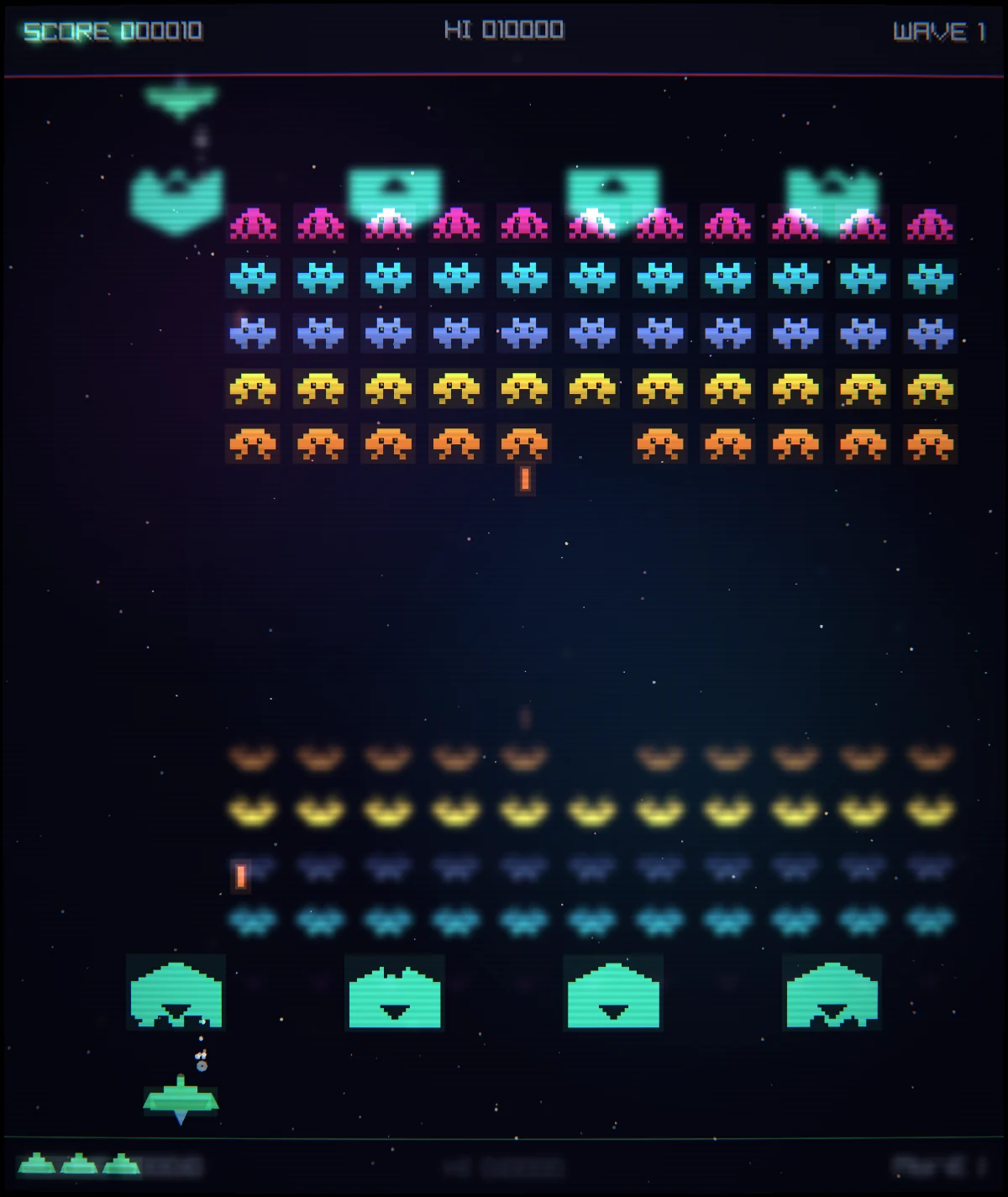
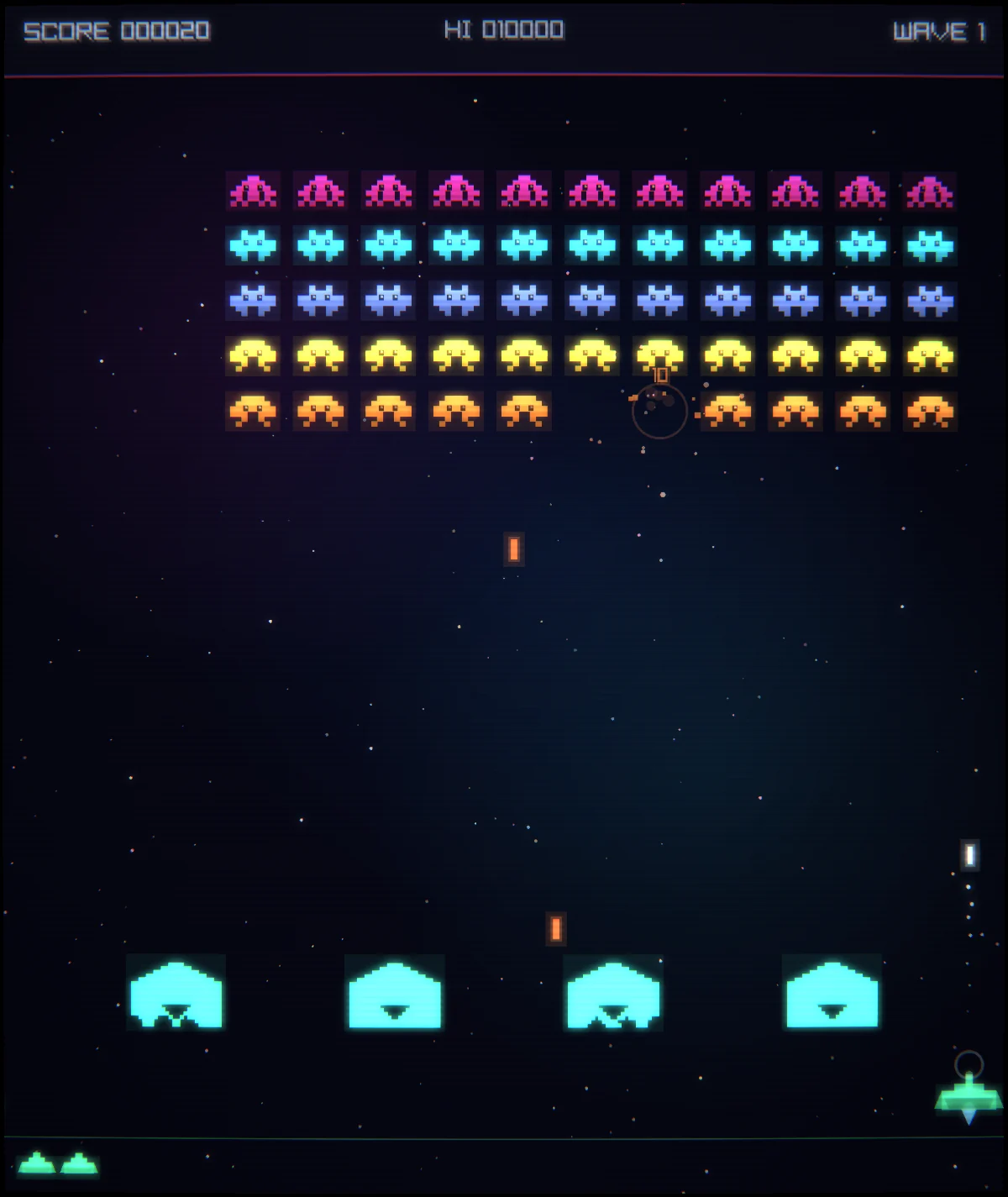
The fix is not in the game’s repository: postfx.cpp has had one commit, the one that added it, and main still draws the bloom upside down.
What we drew, and what we didn’t
Everything on screen is one of two things: a few translucent primitives stacked into a glow, or a bitmask walked cell by cell — then the lot is pushed through a bloom-and-CRT shader chain that lives in the .text section of the executable. No textures loaded from disk, no materials, no atlas, no asset pipeline, and a hard fallback for the machines that can’t run the fancy part.
The rendering department remains laid off. Management notes that output has not measurably changed, and that it was, for the record, the right way up in the meeting.
Next: Every Sound Is a Function — building an entire arcade’s audio at startup with an oscillator, an envelope, and a strict prohibition on touching the audio thread.
A note on the evidence
Observed. The four stage panels and the four before/after frames were captured from release builds of 25bd61d (MSVC 19.44, raylib 5.5, Windows 11, 1200×1425 window), the second build with the one-line diff applied and nothing else changed. The harness copies the canvas, bright-pass and bloom textures out with raylib’s LoadImageFromTexture, flipping all three the same way, just before DrawComposite runs; it does not draw anything. How it works and how to rerun it: the evidence README.
Computed. The HUD’s luma and the knee’s 66% are arithmetic on the shader’s formula and the colour in config.h, on the stored 8-bit values, which is what the shader samples. How much of the HUD’s glow survives the half-resolution downsample and the blur was judged from the panels, not measured.
Corrected in the draft. The draft took config.h’s comment that the HUD colour is “kept below bloom threshold” at its word, and described the bloom as working. Everything else in it was checked line by line against the source at 25bd61d and holds.
Since then. postfx.cpp is unchanged on main (8ff0398). render.cpp and config.h have grown with the later features, but the glow helpers, the bitmasks and the bloom constants quoted here are the same.