Every Sound Is a Function
 Every Sound Is a Function
Contents
The game makes noise. A laser, a wet pop when an invader dies, a warbling UFO, a descending four-note bassline that speeds up as the ranks thin, and a sad falling tone when your cannon gets it. None of that is a file. There is no .wav, no .ogg, no audio middleware. Every sound in the game is a small function that fills an array with floats, and all of them run exactly once, at startup, before the title screen appears.
The invaders would like it noted that they asked for residuals on the bassline. They have crossed this screen since 1978. They have not seen a cent. The bassline, like everything else here, was generated for free by audio.cpp, which is the subject of this part.
This is Part 3 of six on the engineering behind SPACE INVADERS: WE HAVE DEMANDS; Part 2 drew the pictures. Code is quoted from the game at 25bd61d, as throughout the series, and every sound on this page is the game’s own: the exact samples it bakes, copied out as it starts.
The whole thing is baked before you press start
The audio bank is a flat struct — an array of sound effects plus one music loop — and it is filled in a single loop at init:
void InitAudioBank(AudioBank& a) {
    if (!IsAudioDeviceReady()) return;
    for (int i = 0; i < (int)Sfx::COUNT; i++) {
        a.sfx[i] = MakeSfx((Sfx)i);
        SetSoundVolume(a.sfx[i], cfg::kMasterSfx);
    }
    a.music = MakeMusic(a.musicLen);
    SetSoundVolume(a.music, cfg::kMasterMusic);
    a.ready = true;
}
Sfx is a plain enum class — Shoot, Pop, PlayerDie, UfoWarble, …, March0..March3 — and MakeSfx is a big switch that returns a finished Sound for each one. After this loop returns, there is no more synthesis for the rest of the process’s life. Playback is just triggering a buffer that already exists. That’s the entire design: synthesise once, trigger forever.
Everything downstream falls out of that decision. No streaming means no audio callback. No audio callback means no second thread. No second thread means the “no shared mutable state, no function statics” rule the whole codebase lives by holds for audio too. We’ll come back to that at the end, because it’s the load-bearing constraint — but first, how you actually turn a switch case into a laser.
Three primitives: an oscillator, a voice, a bake
The synth is tiny. There is an oscillator enum, a deterministic noise source, a float buffer, a voice that writes into it, and a bake step that hands the result to raylib.
The noise source is a hash, not an RNG. This is a small thing that says a lot about the codebase:
// deterministic noise so synthesis needs no shared rng state
float NoiseAt(int i) {
    unsigned n = (unsigned)i * 2654435761u;
    n ^= n >> 13;  n *= 2246822519u;  n ^= n >> 16;
    return ((float)(n & 0xFFFF) / 32768.0f) - 1.0f;
}
White noise is normally “call rand().” Here it’s a pure function of the sample index — same i, same value, no seed, no shared state. It exists in exactly this form because the project bans function statics, and a stateful RNG in the synth would be one. The constraint from Part 1 reaches all the way down to how we make a hi-hat.
The buffer is just a std::vector<float> sized in seconds at the configured sample rate (44100). Mixing happens in float, which means intermediate sums can blow past ±1 — that’s fine, the bake step deals with it:
struct Buf {
    std::vector<float> s;
    explicit Buf(float seconds) : s((size_t)(seconds * cfg::kSampleRate), 0.0f) {}
};
Voice is the synth. One call adds one tone to the buffer: pick an oscillator, glide the frequency from f0 to f1 over the duration, shape the amplitude with an attack/release envelope, optionally add vibrato. It’s additive — you layer Voice calls to build a sound:
void Voice(Buf& b, float t0, float dur, Osc osc, float f0, float f1, float amp,
           float attack = 0.004f, float release = 0.05f,
           float vibHz = 0.0f, float vibAmt = 0.0f) {
    int start = (int)(t0 * cfg::kSampleRate);
    int n = (int)(dur * cfg::kSampleRate);
    float phase = 0.0f;
    for (int i = 0; i < n; i++) {
        int idx = start + i;
        if (idx < 0 || idx >= (int)b.s.size()) break;
        float t = (float)i / cfg::kSampleRate;
        float f = f0 + (f1 - f0) * (t / dur);              // linear pitch glide
        if (vibHz > 0) f += sinf(t * kTau * vibHz) * vibAmt;
        phase += f / cfg::kSampleRate;
        float v = 0.0f;
        switch (osc) {
        case Osc::Sine:   v = sinf(phase * kTau); break;
        case Osc::Square: v = (fmodf(phase, 1.0f) < 0.5f) ? 1.0f : -1.0f; break;
        case Osc::Saw:    v = 2.0f * fmodf(phase, 1.0f) - 1.0f; break;
        case Osc::Noise:  v = NoiseAt(idx); break;
        }
        float env = 1.0f;
        if (t < attack) env = t / attack;                  // attack ramp in
        float tail = dur - t;
        if (tail < release) env *= tail / release;         // release ramp out
        b.s[idx] += v * amp * env;                         // additive mix
    }
}
Note it accumulates phase incrementally (phase += f / rate) rather than sin(2πft), so a frequency glide stays phase-continuous and doesn’t click. The envelope is a cheap piecewise ramp — linear in, linear out — which is all an arcade blip needs.
Bake finishes the sound. Because voices are summed in float and can clip, the bake step normalises to the buffer’s peak, converts to signed 16-bit, and wraps it in a raylib Wave:
Sound Bake(const Buf& b, float gain) {
    float peak = 0.0001f;
    for (float v : b.s) peak = fmaxf(peak, fabsf(v));
    float k = gain / peak;
    if (k > gain) k = gain;                    // don't amplify silence

    int n = (int)b.s.size();
    short* data = (short*)RL_MALLOC(n * sizeof(short));   // raylib owns/frees it
    for (int i = 0; i < n; i++) {
        float v = b.s[i] * k;
        if (v > 1.0f) v = 1.0f;
        if (v < -1.0f) v = -1.0f;
        data[i] = (short)(v * 32000.0f);
    }
    Wave w{};
    w.frameCount = (unsigned)n;
    w.sampleRate = cfg::kSampleRate;
    w.sampleSize = 16;
    w.channels = 1;
    w.data = data;
    Sound snd = LoadSoundFromWave(w);
    UnloadWave(w);
    return snd;
}
One deliberate detail: the sample buffer is allocated with RL_MALLOC, not new or a vector, so that UnloadWave/raylib frees it with the matching allocator. We’re feeding raylib’s C API, so we allocate the way raylib expects to deallocate. After Bake, the float buffer is gone and all that survives is a Sound handle.
A laser, a death, and a pop
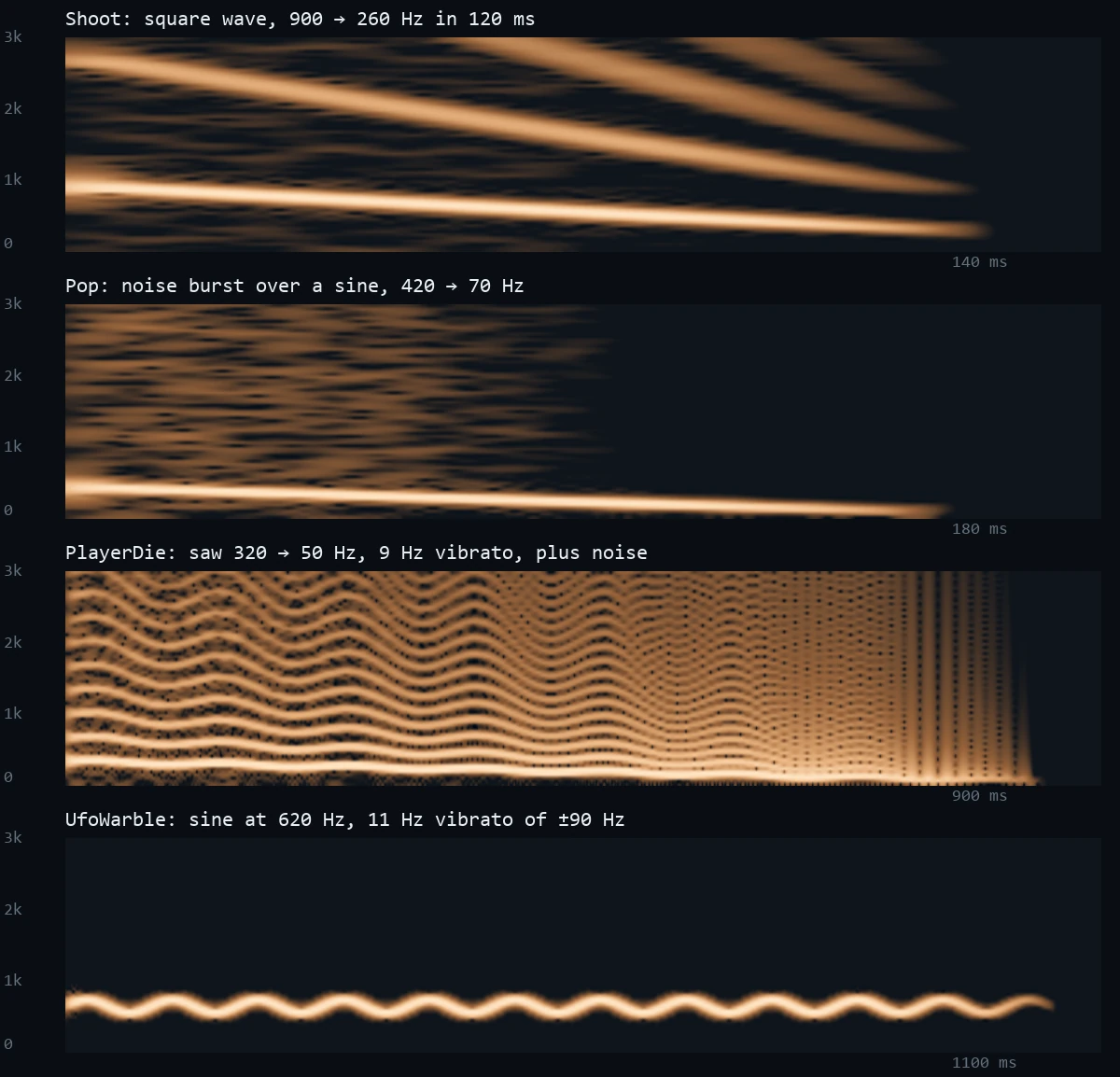
With those three pieces, each effect is three or four lines. The laser is a square wave diving from 900 Hz to 260 Hz over 120 ms:
case Sfx::Shoot: {
    Buf b(0.14f);
    Voice(b, 0, 0.12f, Osc::Square, 900, 260, 0.7f, 0.002f, 0.04f);
    return Bake(b, 0.9f);
}
Sfx::Shoot, 140 ms.The invader pop layers a tonal thud under a noise burst — a sine gliding 420→70 Hz with a short noise transient on top:
case Sfx::Pop: {
    Buf b(0.18f);
    Voice(b, 0, 0.10f, Osc::Noise, 0,   0,  0.5f, 0.002f, 0.06f);
    Voice(b, 0, 0.15f, Osc::Sine,  420, 70, 0.9f, 0.002f, 0.05f);
    return Bake(b, 0.9f);
}
Sfx::Pop, 180 ms.And the “sad descending” player death — the one the design doc calls out by feel — is a sawtooth falling 320→50 Hz with heavy vibrato and a slow release, plus a noise layer for grit. The vibrato (9 Hz, ±20 Hz) is what gives it that queasy, deflating wobble:
case Sfx::PlayerDie: {
    Buf b(0.9f);
    Voice(b, 0, 0.85f, Osc::Saw,   320, 50, 0.8f, 0.004f, 0.2f, 9.0f, 20.0f);
    Voice(b, 0, 0.4f,  Osc::Noise, 0,   0,  0.25f, 0.002f, 0.3f);
    return Bake(b, 0.95f);
}
Sfx::PlayerDie, 900 ms.The pickup chime is three ascending square notes (C–E–G) offset in time; the UFO is a single sine drenched in 11 Hz vibrato. You can read the sound design straight out of the frequencies. It’s the same philosophy as the graphics in Part 2 — the asset is the code that generates it, small enough to read and tweak in place.
Sfx::Pickup: 523, 659 and 784 Hz, C, E and G an octave above middle C.Sfx::UfoWarble: a 620 Hz sine with 11 Hz vibrato of ±90 Hz, 1.1 s.You can also see them. Each strip below is a spectrogram of the baked buffer, computed from the same samples as the players above:
The bassline that keeps time with the invasion
The iconic four descending notes are just four one-shot buffers, generated from a small table:
case Sfx::March0: case Sfx::March1:
case Sfx::March2: case Sfx::March3: {
    const float notes[4] = {110.0f, 98.0f, 87.3f, 82.4f};   // the four descending notes
    float f = notes[(int)id - (int)Sfx::March0];
    Buf b(0.11f);
    Voice(b, 0, 0.09f, Osc::Square, f, f * 0.96f, 0.9f, 0.003f, 0.04f);
    return Bake(b, 0.85f);
}
The tempo is the trick, and it isn’t in audio.cpp at all — it’s an emergent property of how the march works. In invaders.cpp, each march step advances the grid and plays the next note in the cycle:
PlaySfx(*g.audio, (Sfx)((int)Sfx::March0 + g.marchNoteIdx), pitch);
g.marchNoteIdx = (g.marchNoteIdx + 1) % 4;
The march step fires on a timer whose interval interpolates from slow (full grid) to fast (last invader alive) — the classic 1978 acceleration curve from Part 1. In config.h those ends are 0.80 s and 0.06 s. Because the note is played by the march step, the bassline’s tempo is welded to the march tempo for free: kill invaders, the grid speeds up, and the four notes speed up with it, exactly in lock. There is no music-sync code, no beat clock, no separate audio scheduler. The panic you hear is the same timer as the panic you see.
The 16-second loop is a step sequencer
The background music is one more baked buffer, built by a little sequencer — 120 BPM, 64 eighth-note steps, a 16-second loop. Each step optionally lays a bass note, an off-beat noise hat, and a sparse sine arpeggio, all with the same Voice calls:
const float bars[8] = {110.0f, 110.0f, 87.3f, 87.3f, 98.0f, 98.0f, 82.4f, 110.0f};  // bass root per bar
for (int i = 0; i < steps; i++) {
    float t = i * step;
    float root = bars[(i / 8) % 8];
    if (i % 2 == 0) Voice(b, t, 0.20f, Osc::Square, root, root, 0.30f, 0.004f, 0.08f);  // bass, on-beat
    if (i % 2 == 1) Voice(b, t, 0.04f, Osc::Noise, 0, 0, 0.10f, 0.002f, 0.02f);          // hat, off-beat
    // ... sparse arpeggio on some steps ...
}
It reuses the same bass roots as the march notes, so the loop and the invaders are in the same key. The whole soundtrack is one Bake call over a 16-second float buffer, computed before the game starts.
The rule: never touch the audio thread
Here is the constraint the entire file is built to honour, stated in the comment that opens audio.h:
The game stays single-threaded — never use
SetAudioStreamCallback.
audio.cpp opens on the same idea in fewer words: “Single-threaded by design.”
raylib can hand you an audio stream and call you on the miniaudio mixer thread to fill it. That’s the normal way to do live synthesis. It is also exactly what this project refuses to do, because that callback runs on a different thread, and the game’s core invariant — one Game struct, free functions, no function statics, no shared mutable state — assumes a single thread of control. Feeding audio from the mixer thread would mean either duplicating state or reaching across threads into game state, and both break the model that keeps the rest of the code simple.
So instead of streaming, everything is pre-baked into finite Sound buffers, and even the looping is done from the main thread. TickMusic is called once per frame from the main loop and restarts the loop when it’s about to run out:
void TickMusic(AudioBank& a) {
    if (!a.ready) return;
    double now = GetTime();
    if (a.musicStartedAt < 0 || now - a.musicStartedAt >= (double)a.musicLen - 0.02) {
        PlaySound(a.music);
        a.musicStartedAt = now;
    }
}
No callback, no worker, no lock — a timestamp compared against GetTime() on the same thread as everything else. The audio system’s entire concurrency story is: there is no concurrency. That’s not a limitation the project is working around; it’s the point. The same decision that keeps the game legible keeps the audio trivially correct.
Sound, from scratch, on one thread
Sixteen effects and a soundtrack, all generated by an oscillator, an envelope, and a switch, baked to buffers before the first frame and triggered from the main thread ever after. No files, no middleware, no second thread. The synthesiser is about seventy lines, and you can hear every one of them.
The invaders maintain that the bassline is their intellectual property. Legal has reviewed the claim and determined that it is a const float notes[4], which is not, under current statute, eligible for royalties. The matter is considered closed. The march continues.
Next: One Struct, Many Functions — the data-oriented architecture that makes all of this hang together: one Game, a pile of free functions, and a switch where a lesser codebase would have a class hierarchy.
A note on the evidence
Observed. The sounds on this page were copied out of the game at 25bd61d as it started: the capture harness exports each Wave that Bake builds, before raylib loads it (evidence README). The players are those samples encoded as 128 kbit/s MP3; the spectrograms are computed from the samples themselves with a 1,024-sample Hann window. The march clip is the game’s four note buffers placed 0.80 s apart by this page; the game plays them from the march timer, at whatever interval the grid has reached.
Checked against the source. Every code line above was compared with 25bd61d by check_excerpts.py; the differences are spacing, joined lines, and one temporary (t / dur) written inline. The draft of this part condensed Bake’s clamp and its Wave into shorter forms, which are back to the source’s own above; it dropped the last two arguments of the music loop’s bass and hat Voice calls, which set their attack and release; they are restored above. It also said the rule against SetAudioStreamCallback opens both audio.h and audio.cpp, and that the synthesiser is “about a hundred lines”: only audio.h states the rule, and NoiseAt, Buf, Voice and Bake together run from line 15 to line 84 of audio.cpp, about seventy lines.
Since then. main (8ff0398) has seventeen effects, a Scream added after Crunch, and five more lines in audio.cpp; the primitives above are unchanged.