We Have Demands, and So Does the Compiler
 We Have Demands, and So Does the Compiler
Contents
The aliens have read their contract. They have been descending, one row at a time, since 1978, and they would like to point out that the cannon respawns and they do not. They are not evil. They are underpaid, self-aware, and mildly annoyed, and they would like to speak to whoever is in charge.
That is the game. This is the series about how it is built — and, since you are an engineer and not a middle-manager crab, we are going to skip the part where we pretend the jokes wrote themselves. They did not. They are constexpr arrays. Everything here is code, and this first part is the org chart for all of it.
This is Part 1 of six on the engineering behind SPACE INVADERS: WE HAVE DEMANDS, written for C++ programmers; no raylib or shader experience is assumed. The game’s source is public at shaia/space-invader. Every excerpt in the series is quoted from commit 25bd61d, the state the game was in when the series was written, and trimmed to the lines that matter: // ... marks lines left out, and a comment at the end of a line is sometimes there for this page rather than in the source. What has changed since is in the note at the end.
What the game actually is
We Have Demands is a fixed-shooter arcade game — a “Classic+” take on the 1978 original. The 1978 core is treated as sacred: one player shot on screen at a time, a 5×11 grid that marches sideways and speeds up as you thin it out (the classic panic curve), four destructible bunkers, a mystery UFO, and instant game-over if the grid reaches the cannon row.
The “+” is a comedy layer that is load-bearing but never obstructive. The invaders are an org chart. The design doc gives each rank a line: the Squid Executive up top “Complains the most, does the least. C-suite of the invasion.”; the Octopus Intern at the bottom says “I’m not even paid.” Power-ups arrive as corporate memos. Wave modifiers are labour actions. The governing rule, in the design doc’s words: “every modifier gag is also a real mechanical change.” “Opposite Day” doesn’t just flavour a wave — it inverts your controls, and the banner explains why: “Your keyboard has unionized.” When you lose, the game prints GAME OVER, and then, underneath, what it actually means:
The invaders thank you for your service and your quarter.
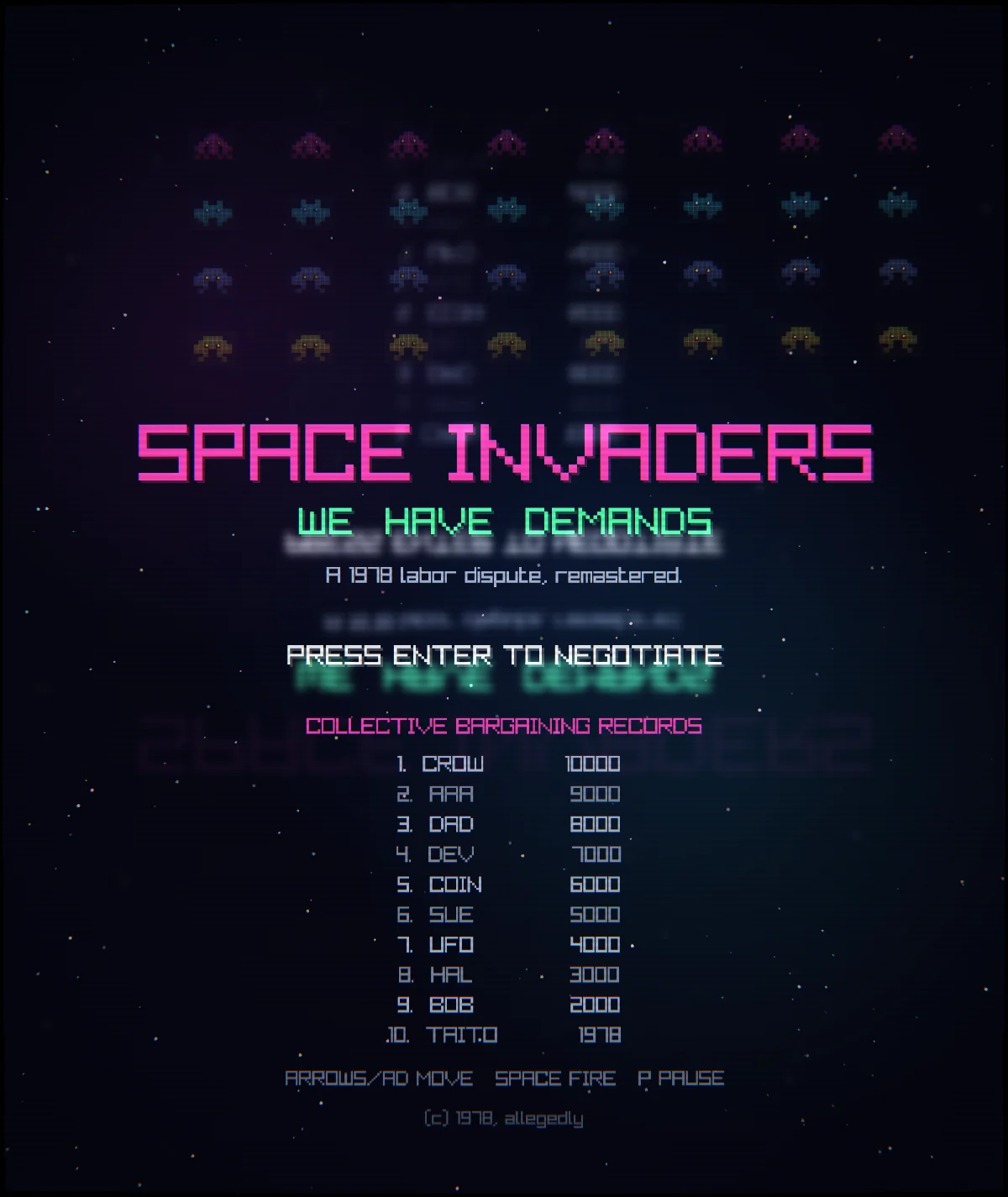
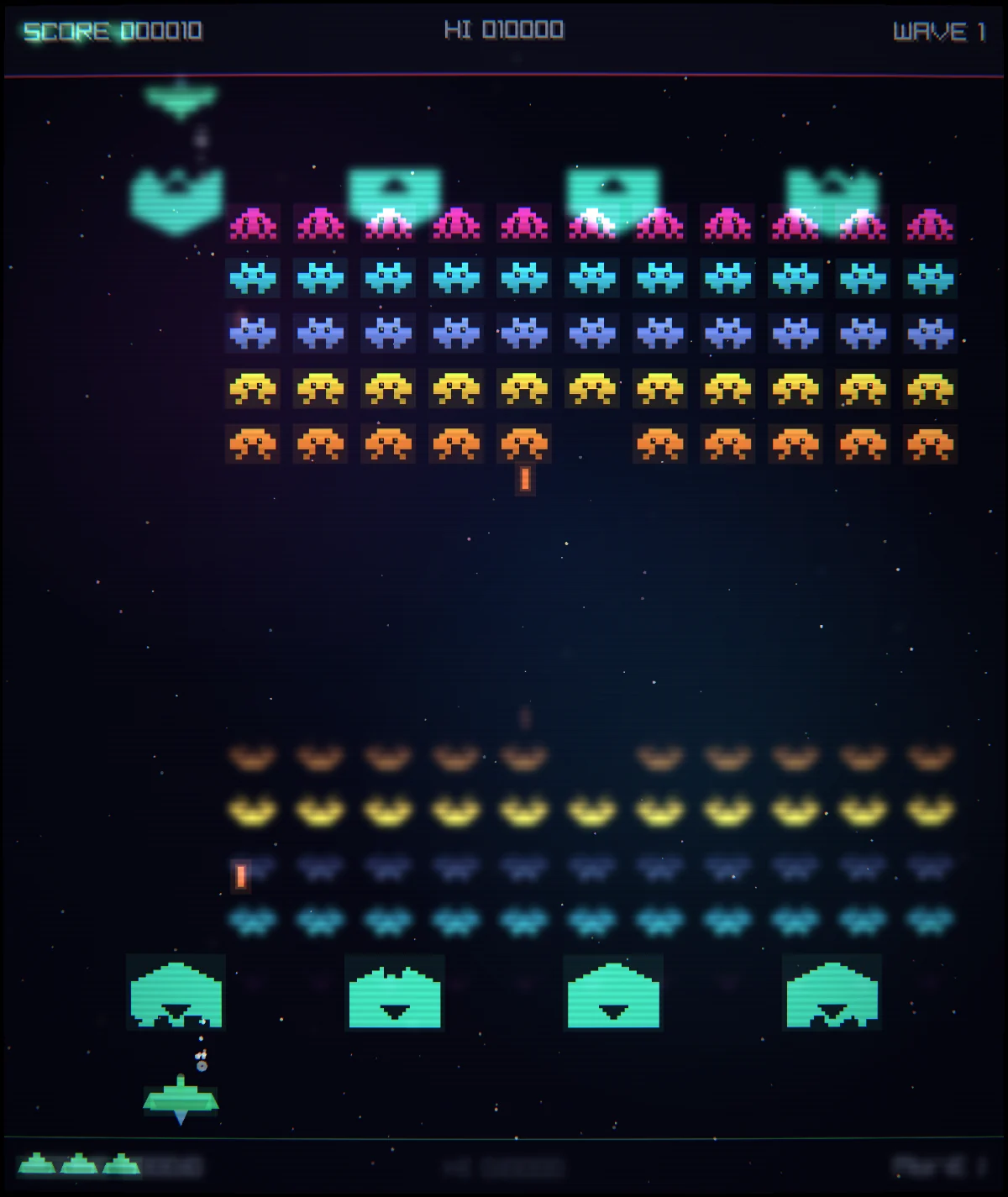
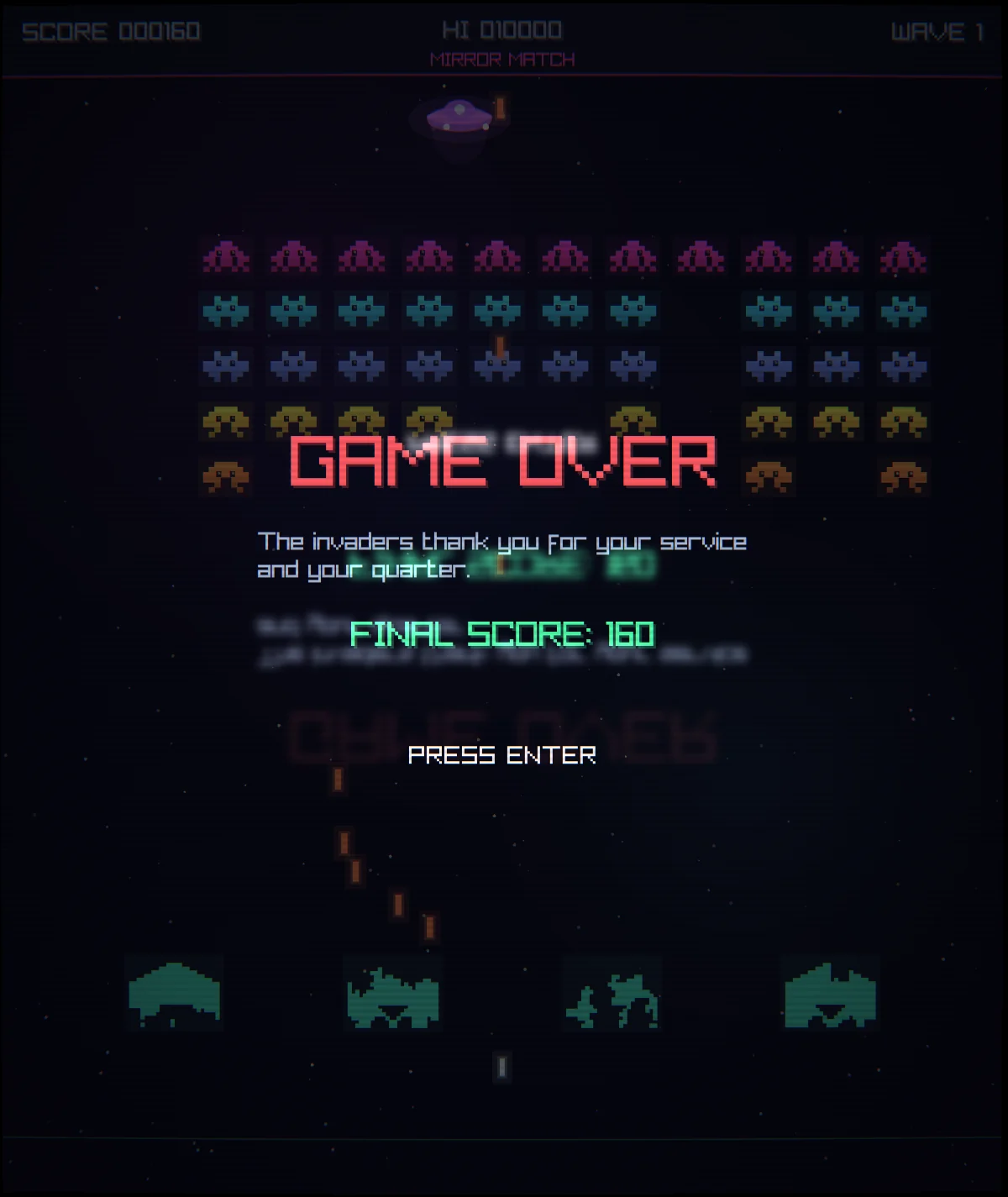
25bd61d, from a release build in a 1200×1425 window; select one for full size. No image file is loaded to draw any of them. The faint upside-down copies (the title reflected under the menu, the bunkers' glow sitting on the top row of invaders, a second GAME OVER below the first) are a real bug in the bloom pass, which Part 2 takes apart.The voice is deadpan corporate throughout — HR memos, arbitration, “legally required.” That register is a design constraint, and, as we will see, it is also an architectural one: because the jokes are data, nearly all of the comedy lives in one header, content.h, and stays out of the code that decides what happens. (Part 5 counts the lines that got away.)
The technical thesis
Two through-lines explain nearly every decision in this codebase. Keep them in mind; the rest of the series is just five ways of proving them.
One self-contained binary. Exactly one dependency (raylib, pinned), fetched and built from source. Zero asset files — every pixel is a primitive drawn at runtime, every sound is synthesised at startup. The shipped artefact is one executable with nothing to locate, load, or lose. There is no
assets/directory because there is nothing to put in it.Aggressively single-threaded simplicity. One
Gamestruct holds all playing state. Subsystems are free functions overGame&. Screens are anenumand aswitch. No ECS, no inheritance hierarchy, no state pattern, no exceptions for game flow, no function-static variables, and — deliberately — no fixed-timestep accumulator. The audio thread is never touched, because there is no audio thread.
Neither of these is an accident, and neither is dogma for its own sake. They are the two invariants that keep a solo-authored game legible. Let’s look at how they show up.
Stack at a glance
C++20 and raylib 5.5. That’s the whole stack. raylib is pulled in with CMake’s FetchContent and pinned to an exact tag — no submodule, no vendored tree, no system package to hunt for:
set(CMAKE_CXX_STANDARD 20)
set(CMAKE_CXX_STANDARD_REQUIRED ON)

include(FetchContent)
set(FETCHCONTENT_QUIET OFF)
set(BUILD_EXAMPLES OFF CACHE BOOL "" FORCE)
set(BUILD_GAMES    OFF CACHE BOOL "" FORCE)
FetchContent_Declare(raylib
  GIT_REPOSITORY https://github.com/raysan5/raylib.git
  GIT_TAG 5.5
  GIT_SHALLOW TRUE)
FetchContent_MakeAvailable(raylib)
GIT_SHALLOW TRUE skips the history; BUILD_EXAMPLES/BUILD_GAMES OFF builds only the library. The first configure needs the network once; after that, deleting build/ re-downloads it. That is the entire “getting started.”
Crucially, raylib is treated as a thin platform layer, not an engine. It gives us a window, input, an audio device, immediate-mode 2D drawing, render textures, and a shader pipeline. There is no framework sitting on top of it — no Entity base class, no scene graph. The game is the free functions and the one struct. raylib is the part that talks to the OS so we don’t have to.
One tooling note that pays for itself immediately: the strict warnings are scoped to the game target only, never globally, because raylib’s C won’t compile clean under them:
if(MSVC)
  target_compile_options(space_invader_plus PRIVATE /W4 /permissive-)
  target_compile_definitions(space_invader_plus PRIVATE _CRT_SECURE_NO_WARNINGS)
else()
  target_compile_options(space_invader_plus PRIVATE -Wall -Wextra)
endif()
We hold our own code to /W4 /permissive- (MSVC’s strict-conformance mode) and -Wall -Wextra, and let the dependency build the way its author intended. That is what PRIVATE is for. (Built for this series with Visual Studio 2022, the game’s sixteen source files produce no warnings at all at that level.)
A tour of the pillars
One Game struct, and functions that operate on it
Here is the load-bearing data structure. All mutable playing state is one flat aggregate:
struct Game {
    Player player{};
    std::array<Invader, cfg::kGridCount> invaders{};  // index = row * kGridCols + col
    int aliveCount = 0;
    float marchTimer = 0.0f;
    int marchDir = 1;
    // ... march animation, bomb timing ...

    std::vector<Shot> shots;     // player + enemy, flag disambiguates
    std::array<Bunker, cfg::kBunkerCount> bunkers{};
    std::vector<PowerUp> pickups;
    ActiveEffects fx{};
    Ufo ufo{};
    Boss boss{};
    WaveState wave{};
    std::vector<Particle> particles;
    std::vector<Star> stars;     // parallax background, seeded in ResetRun
    UiFx uifx{};

    int score = 0;
    int lives = cfg::kStartLives;
    bool gameOver = false;
    // ... shake, run time, achievement watchers ...
    Rng rng{};

    AudioBank* audio = nullptr;  // owned by main
};
There are no methods on Game. Behaviour lives in free functions, and the header reads like a table of contents grouped by owning .cpp file:
// ---- game.cpp ----
void ResetRun(Game& g);
void StartWave(Game& g, int number);
void UpdatePlaying(Game& g, float dt);
void DrawPlaying(const Game& g);
void ResolveCollisions(Game& g);
void AddScore(Game& g, int points);

// ---- invaders.cpp ----
void SpawnGrid(Game& g);
void UpdateInvaders(Game& g, float dt);
void KillInvader(Game& g, int idx);
Fixed arrays for bounded sets (55 invaders, 4 bunkers), std::vector for the unbounded ones (shots, particles), a hand-rolled xorshift Rng seeded once at startup — no <random>, no globals. State and behaviour are cleanly separable, which means “start a new run” is almost literally g = Game{} (restoring the few borrowed handles after). Part 4 is entirely about why this shape scales further than it has any right to.
The loop, and a variable timestep with a leash
Everything hangs off one loop. Note the second line:
while (!WindowShouldClose() && screen != Screen::Quit) {
    float dt = std::min(GetFrameTime(), cfg::kDtClamp);   // 1/30 s ceiling
    screenTimer += dt;
    TickMusic(audio);

    Screen next = screen;

    BeginTextureMode(canvas);
    BeginMode2D(ssCam);
    switch (screen) {
    case Screen::Title:
        next = UpdateDrawTitle(g, hs, screenTimer);
        break;
    case Screen::Playing:
        UpdatePlaying(g, dt);
        DrawPlaying(g);
        // ...
This is a variable timestep — pos += vel * dt, no fixed-step accumulator. The project rule is explicit: don’t add one. But an unbounded dt is a spiral-of-death waiting to happen: one alt-tab stall and a shot teleports straight through a bunker. So dt is clamped to cfg::kDtClamp (1/30 s). Simulation slows below 30 FPS rather than tunnelling — the correct trade for a game where nothing needs sub-frame collision determinism.
The invader march is the one thing not integrated against dt. It’s a timer stepped at an interval that interpolates from slow (full grid) to fast (last invader alive) based on aliveCount. That’s how you get the 1978 acceleration curve without coupling game feel to frame rate — and how the four-note bassline stays locked to the march, because the same timer advances the note index.
Drawing with no pictures
There are no sprites. The neon look is faked in software: DrawGlow* helpers stack two or three translucent halos under each solid shape, and the invaders are drawn from constexpr uint8_t[2][6] bitmask tables (two march frames per archetype) with per-cell shading and animated eye glints.
All of it is drawn into a fixed 800×950 logical canvas, itself rasterised at 2× supersample into a RenderTexture2D under a zoom = 2 camera, so the game stays crisp at any window size:
RenderTexture2D canvas = LoadRenderTexture(cfg::kCanvasW * cfg::kSupersample,
                                           cfg::kCanvasH * cfg::kSupersample);
Camera2D ssCam{};
ssCam.zoom = (float)cfg::kSupersample;
That canvas then goes through a GPU post-processing stage — bloom plus a CRT composite (barrel distortion, chromatic aberration, scanlines, vignette) — compiled from inline GLSL strings, with a graceful fallback to a plain blit if the shaders won’t compile on a given machine. All of that is Part 2.
Sound with no files
Same story, different medium. There are no .wav or .ogg files. At startup, every sound effect is synthesised — a tiny additive synth (Osc oscillators, an ADSR-ish Voice) renders into float buffers, normalises, converts to int16, and hands raylib a Wave to LoadSoundFromWave. Sixteen effects and a 16-second music loop, all baked into Sound buffers before the title screen appears.
And there is a hard rule attached: never use SetAudioStreamCallback. That callback runs on miniaudio’s audio thread, and this game is single-threaded by design — feeding audio from a background thread would break the “no shared mutable state” invariant the whole codebase is built on. So instead of streaming, everything is pre-baked and simply triggered. Part 3 takes the synth apart voice by voice.
Behaviour as data
The last pillar is the one that keeps the other four honest: content and tuning are data, not code. Two headers enforce it.
config.h holds every tuning constant, and opens with the house rule:
All tuning constants live here. If you’re typing a number into a logic file, stop.
content.h holds the jokes. They are constexpr arrays, categorised by trigger — power-up toasts, ambient speech-bubble lines, boss dialogue, the system voice:
inline constexpr const char* kToastFreeze = "UNION-MANDATED BREAK - legally required.";
inline constexpr const char* kToastRapid  = "ESPRESSO OVERRIDE - HR has been notified.";
And wave modifiers — the labour actions — are a plain POD table. A Modifier is a struct of flags and multipliers (invertInput, invisibleInvaders, complimentBombs, mirrorCannon, scale, scoreMult, …), one row per modifier, queried at hook sites throughout the code. No Modifier subclasses, no virtual dispatch — a switch-free data table and a shuffle-bag that picks the next one without repeats. This is what lets the comedy be edited, extended, and tone-audited without touching the engine. Parts 4 and 5 dig into the modifier system and the content/logic split.
What we deliberately didn’t build
The negative space is half the design. There is:
- No ECS. Plain structs in arrays and vectors; dead entities are removed with
std::erase_if. - No state pattern. Screens are an
enumand aswitch. - No inheritance hierarchy and no exceptions for game flow.
- No function-static variables anywhere — state is always passed explicitly.
- No fixed-timestep accumulator — the clamped variable step is the whole story.
- No settings screen, no difficulty menu. The game is the difficulty setting.
Each omission is load-bearing. The absence of an audio callback is why there’s no threading. The absence of function statics is why ResetRun is a near-trivial g = Game{}. The constraints reinforce each other.
Coming up
The rest of the series takes each pillar apart:
- 2 — Drawing with no pictures. The
DrawGlow*layered-halo look, bitmask invaders, and the inline-GLSL bloom + CRT post-processing chain (with its compile-failure fallback, and the bug in the screenshots above). - 3 — Every sound is a function. The startup synth: oscillators, voices, baking to
Wave, the tempo-tracking bassline, and whySetAudioStreamCallbackis forbidden. - 4 — One struct, many functions. The data-oriented architecture in full: the
Gamestruct, free functions, the screenswitch, andResolveCollisions. - 5 — Behaviour as data.
config.h/content.hand the wave-modifier POD table — comedy and tuning expressed as data, checked at hook sites. - 6 — One binary, three platforms. CMake and FetchContent, scoped warnings, per-OS packaging, the one-line
.clangd, and theDEBUG_KEYSinner loop.
The invaders would like it noted that they did not consent to being described as “plain structs.” Their grievance has been logged, categorised, and stored in a constexpr array, where — like every complaint in this game — it will be read exactly when the code decides to read it, and not one frame sooner.
Next: how to draw a convincing arcade with no artist and no images.
A note on the evidence
The code. Every line in every code block above was compared with the source at 25bd61d by check_excerpts.py. Apart from the elisions and the end-of-line comments added for this page, the differences are spacing and line breaks. The game was built at that commit for this series (MSVC 19.44, Visual Studio 2022, raylib 5.5), and the claim about warnings is that build’s output.
The screenshots. They come from that release build, driven by a capture harness force-included into a scratch copy of the game: raylib’s own automation-event playback presses the keys, and each frame is read back before the buffer swap. The game’s source was not edited. The harness, its script and how to rerun it are in the evidence folder’s README. The upside-down glow in them is not the harness: it is in every frame the game draws, at 25bd61d and on main today, and Part 2 shows where it comes from.
What the draft got wrong. This series was written alongside the code, and checking it against the commit changed a few lines here. The design doc’s rule and the invaders’ lines are now quoted rather than paraphrased. The game does print GAME OVER; the line about your quarter comes after it. “Removal via swap-and-pop” went, because nothing in the game pops. And content.h holds most of the jokes rather than all of them, although the design doc says “If it’s funny, it’s in that file”: the modifiers’ names and taglines are a table in modifiers.cpp, the title screen spells out its own text, and three lines sit in game logic (“They have demands.” when the first wave starts, “Paperwork expired.” when a shield runs out, and “scope creep” as the cause of death from a boss’s attack).
What has changed since. main (8ff0398, 12 July 2026) is 30 commits further on, 16 of them changes and the rest their merges: a fourth boss, boss memos, a daily challenge, a performance-review screen, an exit interview, combo streaks, near-miss “hazard pay”, hit-stop, last-invader panic, reactive commentary, falling invaders, six achievements and three more wave modifiers. The shape this series describes is the same there — one flat Game, free functions over it (59 of them declared in game.h), a seven-case screen switch, no inheritance — but the details have grown, which is why every excerpt is pinned to 25bd61d.