The fundamental relation
The puzzle: why temperatures, and not energies?
Drop a hot pebble into a cold lake. A minute later the pebble is at the lake’s temperature, and it holds a vanishing share of the energy — the lake holds essentially all of it. Put two identical blocks together, one hot and one cold, and they end at the same temperature and with the same energy. Put a big block and a small one together, and they end at the same temperature again, with energies that are not remotely equal.
Module 01 watched this happen quantum by quantum and wrote down where it stops. What it never said is why it stops there. Nothing microscopic forbids the flow from carrying on past equal temperatures. Quanta keep hopping in both directions for ever afterwards; each hop conserves energy exactly; a state with more energy in the pebble is just as legal as the one the pebble settles in.
This module answers it, and the answer turns out to be much larger than the question. There is a single function of a system’s state, its entropy written as . Its slopes are the temperature, the pressure and the chemical potential. Its maximum under a constraint is the equilibrium state. Its curvature decides whether that equilibrium is stable. And the one property of being extensive forces two exact relations among everything else. Hand over , and every property of the system follows from it.
Predict before you calculate
Commit to an answer for each of these before reading on. Write them down.
A hot block of copper is pressed against a cold block of copper, and the pair is wrapped in insulation. When they stop changing, do they have equal energies, equal temperatures, both, or neither?
Module 01’s simulation moves one quantum per step between two solids. Track their total entropy step by step as they relax. Can it ever tick down, even for a single step?
A gas doubles its volume by leaking into an empty chamber through a pinhole, with no heat exchanged and no work done. Does its entropy rise, fall, or stay fixed?
Suppose some substance had an entropy that bulged the wrong way — curving upwards over some range of energy. Put two identical pieces of it in contact at the same temperature. What happens?
Explore the model
The laboratory’s centrepiece is a composite: two subsystems inside one isolated box, separated by an internal wall. The totals of energy, volume and particle number are fixed. The wall decides which of them may be redistributed: a wall that conducts heat lets energy move, a wall that slides like a piston lets volume move, and a wall with holes in it lets particles move. The explorer asks one question over and over: of all the redistributions the wall now permits, which one has the largest total entropy?
Here is the simplest version, two Einstein solids — module 01’s model — with a wall that conducts heat.
Two Einstein solids share a fixed total energy; the horizontal axis is the fraction of it that solid A holds. Above: their total entropy, measured from its largest value, which peaks once. Below: the slope of each solid’s own entropy — the red one for A, the blue one for B — which is each solid’s . A’s slope falls as A takes more energy and warms, and B’s rises as B is left with less and cools. The dots sweep across the partitions, and the dotted segment is the gap between the two slopes. Wherever the gap is open the total is still climbing toward the peak; directly beneath the peak, and only there, the gap closes. Solid B is ten times the size of A, and the peak sits at one-eleventh of the energy in A — not at half.
The second picture is a gas in a box divided by a wall, and it releases the constraints one at a time.
Contours of the total entropy of a divided monatomic gas, over the share of the energy and the share of the volume on side A; brighter is higher. The dot starts where the gas was prepared, off the summit. First the wall is made to conduct heat: only the energy share can move, so the dot travels horizontally, and it stops where the temperatures agree — the dashed line. Then the wall is also freed to slide: the dot climbs along that line to the summit, where the pressures agree too. Punching holes in the wall after that moves nothing at all, for a reason the derivation gives.
And the third runs module 01’s simulation again, this time keeping the entropy books.
Above: module 01’s two solids relaxing to a shared temperature, quantum by quantum. Below: the pair’s total entropy, counted exactly from the number of microstates of each solid at every step, minus its starting value. It rises while the temperatures converge and flattens exactly when they meet, just under the dashed line — the largest total entropy any partition of this energy has. Nothing in the simulation knows about entropy; it only moves quanta at random.
Run the laboratory now, then come back. Four things are worth doing before you read on:
Make solid B ten times the size of solid A and find the peak of the total entropy. Read off the two temperatures there, and then the two energies.
Start the partition far from the peak and let module 01’s simulation run. Watch the entropy ledger climb. Then zoom in and look for a step where it goes down.
Release the gas’s constraints in the other order: holes in the wall first, piston second. Does the final state care?
Put two identical “stars” — the convex relation — in contact and look for the peak of their total entropy at the even split. There is a valley there instead.
Derive the result
System and boundary. A single system described by its energy , volume and particle number , and, for most of the argument, a composite of two such systems inside one isolated box, separated by an internal wall.
Independent variables and constraint. , and of each subsystem. Isolation fixes the three totals; the wall decides which of them may be shared out differently between the two sides.
Sign convention. The course convention holds throughout,
with positive into the system and the work done on it.
Route. Eight steps, each using only the ones before it. First the four properties an entropy function must have, and where modules 07 and 08 already established them. Then its slopes, which turn out to be the temperature, pressure and chemical potential. Then the central result, that equilibrium is where those slopes match; then a worked fundamental relation, the Einstein solid’s, which settles the puzzle. Then two exact identities that extensivity alone forces; then why the surface must curve downwards; and finally how much entropy an irreversible process produces.
Step 1: what an entropy function has to do
Modules 07 and 08 built entropy twice, from opposite ends. Module 07 defined it by heat,
along any reversible path, and proved that the integral depends only on the endpoints. Module 08 defined it by counting, , and proved that the logarithm is forced by additivity. This module stops asking where entropy comes from and asks what it does. From here on we take four of its properties as the starting point.
These are postulates in the sense that everything below is derived from them and nothing below derives them. But they are not guesses. Each has already been met in this course.
Additivity is module 08’s theorem: independent subsystems have multiplicities that multiply, and the logarithm turns the product into a sum. Module 07’s Clausius entropy is additive too, because heat flowing into a composite is the sum of the heat flowing into its parts.
Increasing in energy is the statement, in module 07’s language, that temperature is positive: adding heat reversibly at fixed volume raises by .
Maximisation is module 08’s peak, read the other way round. There the even split won not because anything forbade the corner but because it had overwhelmingly more microstates; the macrostate with the largest is the one with the largest . Module 07 reached the same place from the other side: an isolated system’s entropy can only rise.
Concavity is the one that is new, and step 7 shows it is the condition for a system to be stable.
Extensivity deserves a warning. Module 08 measured that is extensive only in the limit of large , with corrections of order that never vanish exactly. The postulate takes the limit as given. It is excellent for a gram of anything and wrong for a nanoparticle, and it fails outright for a star — step 7 comes back to that.
Step 2: the slopes of the surface are the intensive variables
Write the change in between two neighbouring equilibrium states as
The three partial derivatives are properties of the state, like itself. Give them names.
The first two had better be the temperature and pressure you already know, and the definitions have to be checked against them rather than assumed. Here is the check.
Temperature. Heat the system reversibly at fixed and . No work is done, so the first law and module 07’s definition of entropy give
Divide one by the other: the slope is , with the thermodynamic temperature of module 07.
Pressure. Compress the system reversibly and adiabatically at fixed . No heat flows, so its entropy does not change, while the first law gives
with the force per area the piston feels. Setting to zero in the expansion above,
so is exactly the mechanical pressure.
Substituting the three slopes into and solving for gives the most used equation in thermodynamics.
A test on a real relation. For a monatomic ideal gas the fundamental relation is known in closed form.
Take its slopes. Only one term depends on , and only one on :
The first is module 04’s kinetic temperature, and the second is module 02’s ideal gas law:
Neither was put in. Both came out of a single function by differentiating it, which is the whole claim of this module in miniature.
Step 3: equilibrium is where the slopes match
Now the central result. Take the composite: two systems in an isolated box, with a wall between them that conducts heat but does not move and has no holes. The total energy is fixed; how it is shared is not. Give subsystem 1 the energy , and subsystem 2 the rest:
By the maximum postulate, the wall’s energy settles where this is largest. At a maximum the derivative vanishes, and by the chain rule the second term contributes a minus sign:
The pressure and particle versions come the same way: release the volume at fixed total volume and differentiate with respect to , and the slopes must match; with the temperatures already equal, so must the pressures. One caution the laboratory enforces: a wall that moves or lets particles through always carries energy across too — a moving piston does work, and a crossing particle takes its energy with it — so those constraints are only ever released together with the energy one.
Which way does energy flow? Before equilibrium, the total entropy is still rising, so a small transfer into subsystem 1 must have
If , the bracket is positive, and so is : energy flows into the colder body. A steeper — a larger — means a colder body, and giving it energy buys more entropy than the hotter body loses by giving that energy up. Heat flowing from hot to cold is not a separate law. It is the maximum postulate, applied one transfer at a time.
The puzzle, resolved. The condition is on slopes, and nothing ties a slope to a size. A big body and a small body can have the same slope with wildly different energies, and at equilibrium they do. The pebble ends at the lake’s temperature holding almost none of the energy; the lake’s is so gently curved that absorbing the pebble’s heat barely changes its slope, which is exactly what makes it a reservoir. What is maximised is the total entropy, and the only thing that condition ever equalises is .
Is it really a maximum? A vanishing derivative could be a minimum too. The second derivative settles it:
By the concavity postulate both terms are negative or zero, so the equal-slope point is a maximum. Step 7 shows what goes wrong without that postulate.
Step 4: a fundamental relation worked through — the Einstein solid
Module 01’s solid is oscillators sharing identical quanta of energy , so
its energy is . How many ways can identical quanta be shared among
oscillators? Line the quanta up as dots and separate the oscillators with bars: every
arrangement of the dots and bars in a row is one microstate. With four quanta among three
oscillators, the row ●●|●|● gives the first oscillator two quanta and each of the others
one. So the count is the number of ways to choose which of the positions hold dots:
For four quanta among three oscillators that is 15. For macroscopic and , Stirling’s approximation from module 08 turns into
This is a fundamental relation. The solid has no volume to speak of, so depends on and on its size ; scale both together and scales with them, so it is extensive. Its energy slope is the temperature:
When the solid is hot, is much larger than , so the logarithm’s argument is only slightly above one and the logarithm can be expanded in powers of the small excess. Keeping the first two terms,
which is module 01’s map from quanta to temperature, plus an offset of half a quantum that matters less and less as the solid warms. Module 01 assumed that map by equipartition; here it has come out of counting. Inverted, the exact slope gives
Einstein’s formula of 1907, whose falling heat capacity at low temperature module 16 takes up.
Two unequal solids. Put solid A, with oscillators, against solid B, with . Equal slopes means equal logarithms, and so
Each oscillator ends with the same average energy, so each solid’s share of the energy is its share of the oscillators. With , solid A ends with one part in eleven. That is prediction 1 answered: equal temperatures, and energies in the ratio of the sizes.
Step 5: extensivity forces the Euler relation
The first postulate said that scaling a system scales its entropy. As an equation, for every ,
A function with this property is called homogeneous of degree one, and there is a short theorem about such functions. Differentiate both sides with respect to . On the left the chain rule gives one term per argument; on the right the result is just :
This holds for every , so set and replace each slope by its name from step 2:
Multiply by and rearrange.
There is a second way to see it, which shows where extensivity enters. Build the system up from nothing by adding more and more of it at a fixed temperature, pressure and chemical potential, as a crystal grows in its own melt. Along that one path , and never change, so the differential form of step 2 integrates term by term, and it gives exactly the Euler relation. What makes that path available is extensivity: only if a bigger piece of the same stuff has the same intensive state can the system be grown without changing , and . Along any other path they change, and the naive integration is wrong.
For one mole of argon at and , Sackur–Tetrode gives these values, and the Euler relation can be checked with a calculator:
Step 6: the Gibbs–Duhem relation
Now there are two expressions for in hand. Differentiate the Euler relation, using the product rule on each term:
Subtract the differential form from step 2. The three terms of that equation cancel, and what is left must vanish.
This is why, in the second animation, punching holes in the wall moved nothing. Once the temperatures and the pressures on the two sides agreed, the Gibbs–Duhem relation left the chemical potentials no freedom to differ: the same gas at the same and has the same . The three equilibrium conditions of step 3 are not three independent demands.
A useful special case: hold the temperature fixed. Then the change in is times the change in pressure, and for an ideal gas is , so
Module 13 builds on this line.
Step 7: concavity is stability
The postulates asked for a concave . Here is why a system that broke the rule could not exist in equilibrium with anything.
Differentiate the temperature slope once more. With as the first derivative,
where the heat capacity is the derivative . So the sign of the curvature is the sign of the heat capacity, reversed.
The runaway. Take two identical pieces of a substance, each with energy , in contact. Move a small amount of energy from one to the other. The total entropy goes from to
If curves downwards, the chord between those two points lies below the curve, the new total is smaller, and the transfer is undone: the fluctuation dies. If curves upwards, the new total is larger, the maximum postulate rewards the transfer, and the next transfer in the same direction is rewarded more. The energy segregates. In the language of temperature: with a negative heat capacity, the piece that loses energy gets hotter, so heat flows back out of it faster, and the difference grows instead of shrinking.
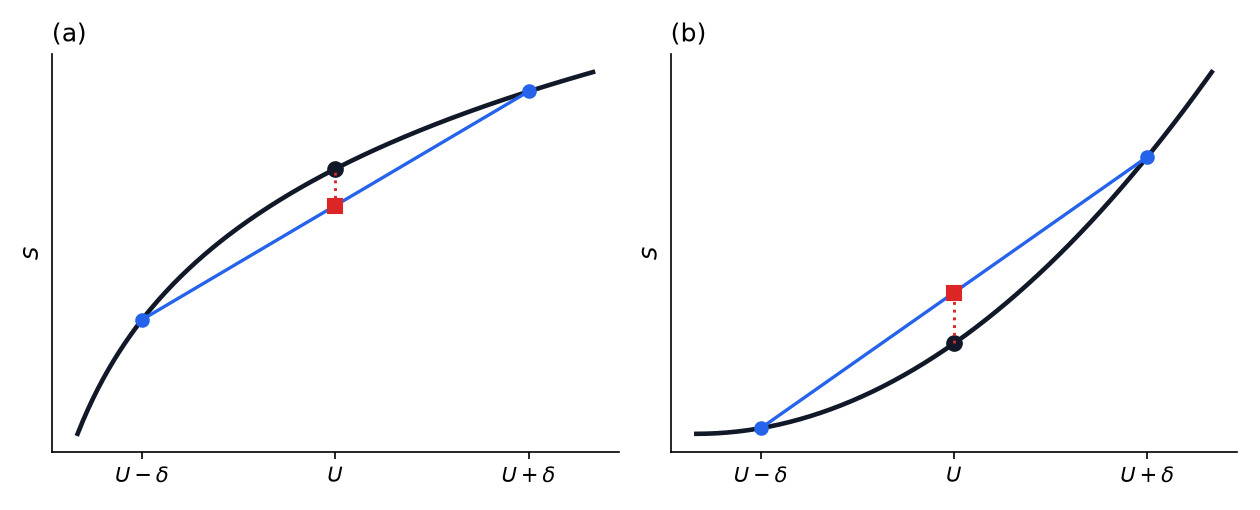
The runaway in one picture. Two identical pieces start at the middle energy . Sharing out a fluctuation moves them to the two ends of the chord, and the chord’s midpoint is their new average entropy. (a) A concave : the chord’s midpoint is below the curve, so the fluctuation lowers the total entropy and is undone. (b) A convex : the midpoint is above the curve, so the fluctuation raises the total entropy and grows.
The volume direction. With two variables in play, “curves downwards in every direction” has a precise meaning. Write , and for the second partial derivatives of at fixed , the last being the mixed one. A small step , in any direction must change , at second order, by a negative amount:
A quadratic expression like this is never positive, whatever the step, exactly when
Now squeeze the system at fixed temperature. Its first slope is , so keeping fixed means an energy change must accompany the volume change and cancel its effect on that slope:
The volume slope is , and with fixed its change is the change in pressure divided by . Substituting the energy change from the line above,
and so
The numerator is not negative and the denominator is negative, so compressing at fixed temperature can only raise the pressure. That is the statement that the isothermal compressibility,
is never negative. On the Sackur–Tetrode surface the mixed derivative vanishes, and the formula returns exactly one over the pressure — the ideal gas’s compressibility, read off the curvature of its entropy. The runaway argument has a mechanical twin here: if a substance’s pressure fell when it was squeezed, a movable wall between two identical samples would be pushed further by any small displacement, and the pair would separate into a dense region and a dilute one. That is exactly what the van der Waals loop below its critical temperature would do, and it is why a real gas condenses there instead.
The energy runaway, for its part, is not hypothetical. A star is a ball of gas held together by its own gravity, and the virial theorem says its total energy is minus its kinetic energy:
A star that radiates energy away heats up. Two stars could never settle at a common temperature, and a star cannot be put in equilibrium with a heat bath. It escapes the argument by breaking the first postulate: gravity is long-ranged, a star twice the mass is not two stars, and its entropy is not extensive. The laboratory includes this relation, and the Euler relation of step 5 fails on it by exactly twice its energy.
Step 8: entropy produced, computed
Module 07 defined the entropy produced by a process as the total change of the system and of everything it exchanged heat with, and proved it is never negative. This step computes it for two processes that module 07 could only bound.
Two bodies at different temperatures. Put body A, heat capacity , at against body B, at , and insulate the pair. Energy conservation fixes where they end, as module 01 found:
Each body’s entropy change is module 07’s constant-heat-capacity result, and nothing crosses the pair’s outer boundary, so their sum is all produced:
Why is this positive? Divide by and write and for the two bodies’ shares of the total heat capacity. The final temperature is the weighted average of the starting ones, and the entropy change is the logarithm of that average minus the weighted average of the logarithms. The logarithm is concave, so the logarithm of an average always beats the average of the logarithms — the same chord picture as step 7:
with equality only when the two starting temperatures are equal.
A free expansion. A gas leaks from into an evacuated chamber until it fills . No heat, no work, so is unchanged, and so is . The Sackur–Tetrode equation depends on through one term, , so
That makes three independent routes to one number. Module 07 took a reversible isotherm between the same two end states and integrated . Module 08 counted: each atom has times the room, so grows by that factor to the power . And here it is a difference of two values of one function. Prediction 3 is answered three times over: the entropy rises, although nothing flowed in. Nothing in between was an equilibrium state, and it did not need to be — belongs to the endpoints, and both endpoints are equilibrium states.
Flow and production are different things. It is tempting to think entropy is produced wherever it moves. It is not.
A gas expanding reversibly along an isotherm at , in contact with a bath at the same , takes in heat . Entropy flows into the gas and the same flows out of the bath, and nothing is produced: a great deal of flow, zero production. Now let the same heat cross from a body at into one at with . It leaves A carrying and arrives in B bringing , which is more; the difference,
was produced in the crossing. That is the whole of the contact formula above, one sliver of heat at a time.
Verify computationally
The derivation is a chain of exact statements. The laboratory checks that each link was assembled correctly, on the two relations of this module and on a third, the star, that deliberately breaks the rules. Each check is also a test in the project’s suite.
1. The slopes are the equations of state. Numerical derivatives of the Sackur–Tetrode function, with nothing else supplied, return the temperature and pressure the state was built with to about one part in 108, and a chemical potential that matches , with the thermal wavelength, to one part in 106.
2. The Einstein slope is the Einstein temperature. At every energy tried, from half a quantum per oscillator to two hundred, the numerical slope of the Stirling-form agrees with the closed form of step 4 to one part in 107. As the solid heats, the temperature approaches module 01’s map with an offset that settles at exactly half a quantum.
3. The maximiser finds equal slopes. Released through a heat-conducting wall, a solid of 40 oscillators and one of 400 end at the same temperature to one part in 106, with the energy split exactly . The divided gas, with its wall freed to slide, ends with equal temperatures and equal pressures; perforating the wall afterwards changes the total entropy by less than one part in 1012.
4. Euler and Gibbs–Duhem close — and can fail. For both extensive relations, the Euler relation balances to about one part in 108 of , and the Gibbs–Duhem sum along a small displacement vanishes to one part in 105 of its terms, shrinking fourfold every time the displacement is halved. The star’s Euler residual is not small. It is 2.000, in units of : the relation misses exactly twice the energy, as its non-extensive entropy predicts.
5. The curvature is the heat capacity. The second derivative of Sackur–Tetrode gives a heat capacity of to one part in 105. The star gives , and the stability test rejects it. The full curvature in energy and volume, fed through the formula of step 7, gives the gas’s isothermal compressibility as one over its pressure, again to one part in 105.
6. The ledger of module 01’s simulation. Two solids of 300 and 100 oscillators, started at and with quanta of , relax as in module 01. The ledger counts each solid’s microstates exactly at every step.
The module-01 hop rule moves quanta as if they were labelled, so its own long-run distribution is not exactly the Einstein count: it peaks at almost the same partition — here within two tenths of a percent — but its jitter about the peak is narrower than a true Einstein solid’s. The rise and the plateau, which are what the ledger tests, are unaffected.
7. Three entropies of one contact. The same relaxation can be priced three ways. The exact count says . The Stirling-form surface of step 4 says . The contact formula of step 8, with module 01’s heat capacities , says .
8. Free expansion, three ways. Doubling the volume of atoms gives from the Sackur–Tetrode difference, from module 07’s ideal-gas formula, and from the heat absorbed along a reversible isotherm divided by its temperature — to nine significant figures in every case.
Transfer the idea
Looking back:
Module 01 found that two bodies stop exchanging energy at equal temperatures and gave the equilibrium temperature a formula. The reason it stops there is now in hand: that partition maximises the total entropy, and temperature is the slope that the maximum equalises.
Module 06 left the free expansion’s entropy as a question, and module 07 answered it with a reversible isotherm. Here it is a difference of two values of one function.
Module 07’s Clausius entropy and module 08’s Boltzmann entropy are two constructions of one function. This module never needed to say which it was using, because both have the properties the postulates ask for.
Module 08’s narrow peak is why the maximum is all that matters: fluctuations about it are a fraction of the whole, invisible in anything macroscopic.
Looking ahead:
Module 10 trades for functions whose natural variables are the ones a laboratory controls — temperature and pressure rather than energy and volume. Everything there is built by differentiating the surface of this module.
Module 11 puts a small system against a huge one and reads the huge one’s slope , its , as the only thing the small one ever feels. That is where the Boltzmann factor comes from.
Module 13 develops the chemical potential that was only named here.
Module 14 starts exactly where concavity fails.
And in the laboratory:
Calorimetry works because of step 3. Mixing a hot sample into a known mass of water and reading the final temperature measures heat capacities only because the mixture settles at a single, reproducible temperature, fixed by energy conservation and equal slopes.
The entropy of argon. The Sackur–Tetrode value for one mole of argon at and is , and the tabulated standard molar entropy is . The same entropy can be measured with no formula at all, by calorimetry — integrating up from near absolute zero through melting and boiling — and for the noble gases the two agree to within a fraction of a percent. A formula with Planck’s constant in it and a stack of heat-capacity measurements land on the same number.
Worked examples
Try each one before opening its solution.
Worked example 1 — sharing out the quanta. Solid A has 100 oscillators and solid B has 300. Together they hold 2000 quanta of size . At equilibrium, how many quanta does each hold, and what is their common temperature?
Solution
Worked example 2 — mixing water. Half a kilogram of water at is poured into at in an insulated flask. Take the specific heat as . Find the final temperature, each part’s entropy change, and the entropy produced.
Solution
The heat capacities are and , and the final temperature is their weighted average:
Each part’s entropy change is :
The hot water’s entropy fell, and nothing is wrong: the second law constrains the total. The same of heat left the hot water and entered the cold, but it left from hotter water, carrying less entropy per joule than it delivered. The was produced in the crossing.
Worked example 3 — checking Euler on argon. For one mole of argon at and , Sackur–Tetrode gives . Find , and , and check the Euler relation.
Solution
The slopes of step 2 give the energy and the product of pressure and volume:
For , differentiate Sackur–Tetrode with respect to . Every term of depends on only through and , which together contribute per particle, so
Then
which is . Note what is doing: it is large and negative, because adding an atom to a dilute gas at fixed energy and volume raises the entropy by a lot.
Worked example 4 — Gibbs–Duhem at work. Argon at is compressed isothermally from to . By how much does its molar chemical potential change?
Solution
At fixed temperature Gibbs–Duhem leaves
and for an ideal gas is . Per mole,
The chemical potential rises with pressure: squeezed atoms have less room, so each one added at fixed energy and volume buys less entropy. Module 13 will show that particles move from higher to lower, which is why a gas leaks from high pressure to low.
Worked example 5 — the price of a free expansion. One mole of an ideal gas at doubles its volume by leaking into a vacuum. How much entropy is produced, and how much work was lost compared with the best possible route to the same final state?
Solution
Worked example 6 — a star. A star of particles radiates away energy at a rate . Use its heat capacity to find how its temperature changes.
Solution
With the star’s energy from step 7, losing energy at the rate means
It heats up. The star contracts, its gravitational energy falls by twice what it radiates, and half of that goes into making its gas hotter. Put it in contact with anything cooler and the exchange runs away rather than settling — the convex picture of step 7, in the sky.
Check your understanding
This module takes four properties of the entropy as its starting point. Which of the following is one that module 08 had already PROVED from counting, rather than one that this module simply assumes?
A. Entropies of independent subsystems add, because their multiplicities multiply and the logarithm turns a product into a sum. B. The entropy surface is concave in every direction. C. Entropy is exactly extensive at every system size. D. The equilibrium temperature is the heat-capacity-weighted average of the starting temperatures.
Check your answer
Correct answer: A — Entropies of independent subsystems add, because their multiplicities multiply and the logarithm turns a product into a sum.
A. Right. Given S = k_B ln Omega and independent subsystems, additivity is a theorem: Omega_AB = Omega_A Omega_B, so S_AB = S_A + S_B. The postulates list it anyway, because the thermodynamic argument has to stand on its own, whichever construction of S you started from.
B. Concavity is the one postulate neither module 07 nor module 08 established. It is assumed here, and its content is stability: a concave S is a positive heat capacity. Stars break it, so it cannot be a theorem about all matter.
C. Module 08 measured the opposite: k_B ln Omega is extensive only in the limit of large N, with ln N corrections that never vanish exactly. The postulate takes the limit as given, which is an assumption, not something 08 proved.
D. That is module 01’s result from energy conservation, not a property of the entropy function at all. This module explains why the flow stops there; it does not take it as a postulate.
A hot 2 kg block of copper and a cold 0.2 kg block of copper are pressed together and insulated from everything else. What is true once they stop changing?
A. They have equal temperatures, and the big block holds about ten times the small block’s energy. B. They have equal energies, because equilibrium shares the energy out evenly. C. They have equal temperatures and equal energies, since each follows from the other. D. Neither is equal; the flow stops when the entropy of each block separately stops rising.
Check your answer
Correct answer: A — They have equal temperatures, and the big block holds about ten times the small block’s energy.
A. Right. Maximising the total entropy sets the slopes dS/dU of the two blocks equal, and that slope is 1/T. Nothing ties a slope to a size, so the energies end in the ratio of the heat capacities, here 10 : 1.
B. This is the equal-energy misconception. What equilibrium maximises is the total entropy, and at the maximum the two slopes of S(U) agree, not the two energies. A pebble dropped in a lake ends at the lake’s temperature holding almost none of the energy.
C. Equal temperatures imply equal energies only for two identical bodies. For bodies of different sizes the same temperature means different energies, in proportion to their heat capacities.
D. The hot block’s entropy falls the whole time, so waiting for each block’s entropy to stop rising gives nothing. What stops rising is the TOTAL, and it peaks exactly where the temperatures agree.
A table of a system’s entropy at fixed volume and particle number gives S = 2.3400 J/K at U = 99.0 J and S = 2.3466 J/K at U = 101.0 J. Estimate the system’s temperature at U = 100 J, in kelvin.
Check your answer
Correct answer: 303.0 (± 3.0)
The slope is dS/dU = (2.3466 - 2.3400) / (101.0 - 99.0) = 0.0033 K^-1, and that slope is 1/T, so T = 1/0.0033 = 303 K. A central difference like this one is accurate to second order in the step. If you got 0.0033 you stopped at the slope; if you got about 7 you divided S by U, which is not a derivative.
Two systems share a heat-conducting wall. At the moment, the slope dS_1/dU_1 of system 1 is larger than the slope dS_2/dU_2 of system 2. Which way does energy flow?
A. Into system 1, which is the colder of the two. B. Into system 2, because a steeper slope means a hotter body. C. Nowhere; energy flows only when the energies differ, not the slopes. D. It cannot be decided without knowing the two heat capacities.
Check your answer
Correct answer: A — Into system 1, which is the colder of the two.
A. Right. Moving dU into system 1 changes the total entropy by (dS_1/dU_1 - dS_2/dU_2) dU, which is positive, so the transfer is favoured. A larger slope is a larger 1/T, a lower temperature: heat flows to the colder body because that raises the total entropy.
B. The slope is 1/T, so steeper means colder, not hotter. Check with the sign of the entropy change: moving energy into system 2 lowers the total entropy here.
C. Energy keeps flowing until the slopes match, whatever the energies are. Two bodies of very different energy can be in equilibrium, and two of equal energy need not be.
D. The heat capacities decide how far each temperature moves, and so where the flow stops. The direction is fixed by the slopes alone.
For some one-component system, T = 300 K, S = 150 J/K, P = 1.00e5 Pa, V = 0.0250 m^3, and the product mu N = -40000 J. Use the Euler relation to find the internal energy U, in joules.
Check your answer
Correct answer: 2500 (± 20)
U = T S - P V + mu N = 45000 - 2500 - 40000 = 2500 J. Watch the two signs: the PV term enters with a minus, and mu N is itself negative here. The Euler relation needs nothing but extensivity, so these numbers are consistent with any extensive system.
A one-component system’s temperature is changed by dT and its pressure by dP. Can its chemical potential change by any amount you like?
A. No. The Gibbs-Duhem relation fixes it at dmu = (V dP - S dT) / N. B. Yes. T, P and mu are three independent state variables. C. Only if the system is an ideal gas; otherwise it is free. D. Yes, but only if N is also allowed to change.
Check your answer
Correct answer: A — No. The Gibbs-Duhem relation fixes it at dmu = (V dP - S dT) / N.
A. Right. S dT - V dP + N dmu = 0 leaves no freedom: of the three intensive variables, only two can be chosen. This is why, once two subsystems of the same substance agree on T and P, they automatically agree on mu.
B. They look independent, but extensivity ties them together through Gibbs-Duhem. A single phase has only two independent intensive variables.
C. Gibbs-Duhem uses nothing about the ideal gas. It follows from the Euler relation, which needs only extensivity, so it holds for every substance.
D. The relation involves N itself, not dN; changing the amount of substance at fixed T and P changes nothing intensive. mu is fixed by T and P either way.
Suppose a substance’s entropy S(U) curved UPWARDS over some range of energy. Two identical pieces of it, in that range and at the same temperature, are put in contact. What happens?
A. Any small transfer of energy between them raises the total entropy and grows, so the pieces run away to a hot one and a cold one. B. Nothing observable; they stay in equilibrium, because their temperatures are equal. C. They stay at equal temperatures but their energies oscillate back and forth forever. D. The substance would have to be at negative absolute temperature.
Check your answer
Correct answer: A — Any small transfer of energy between them raises the total entropy and grows, so the pieces run away to a hot one and a cold one.
A. Right. On a convex curve the chord lies above the curve, so S(U + delta) + S(U - delta) exceeds 2 S(U): every fluctuation is rewarded. Equivalently the heat capacity is negative, and the piece that loses energy gets hotter. A star is such a system.
B. Equal temperatures make the equal split a stationary point of S_total, but on a convex curve it is a minimum, not a maximum. Any fluctuation moves the pair away, and nothing moves it back.
C. Oscillation would need a restoring tendency, and a convex entropy supplies the opposite: every departure from the equal split raises the total entropy further.
D. The slope can be positive while the curvature is positive, as it is for a star. What a convex S gives is a negative heat capacity, not a negative temperature.
One kilogram of water at 350 K is mixed with one kilogram of water at 290 K in an insulated flask. Take the specific heat as 4184 J/(kg K). Compute the total entropy produced, in J/K.
Check your answer
Correct answer: 36.94 (± 0.5)
T_eq = 320 K. Delta S_total = 4184 ln(320/350) + 4184 ln(320/290) = -374.9 + 411.9 = 36.9 J/K. The hot water’s entropy fell and the cold water’s rose by more. If you got zero you assumed the heat Q carried equal entropy out and in, but it left at a higher temperature than it arrived: Q/T_hot is less than Q/T_cold.
An ideal gas expands slowly along an isotherm at 300 K, in contact with a bath at exactly 300 K, absorbing 600 J of heat. What happens to entropy?
A. 2 J/K flows from the bath into the gas, and none is produced. B. 2 J/K is produced, because entropy moved into the gas. C. 4 J/K is produced, 2 J/K in the gas and 2 J/K in the bath. D. No entropy moves at all, because the temperature stayed constant.
Check your answer
Correct answer: A — 2 J/K flows from the bath into the gas, and none is produced.
A. Right. The gas gains Q/T = 2 J/K and the bath loses exactly 2 J/K: entropy has moved, and the total has not changed. Production needs an irreversibility, such as heat crossing a temperature difference; flow on its own is not one.
B. This is the flow-is-production misconception. The bath’s entropy fell by exactly what the gas’s rose, so the total change, which is what production means, is zero.
C. The bath gave up heat, so its entropy fell, it did not rise. The two changes cancel exactly for a reversible exchange.
D. Constant temperature does not mean constant entropy. The gas took in 600 J of heat at 300 K, and that carried 2 J/K of entropy in with it.
A gas at 300 K rushes freely from 1 L into an evacuated 2 L box. None of the states in between is an equilibrium state. What can be said about the gas’s entropy change?
A. It is N k_B ln 2, found by any reversible path between the same two equilibrium end states. B. It cannot be computed, because entropy is defined only at equilibrium and the process passed through none. C. It is zero, because no heat was exchanged. D. It is negative, because the gas cooled as it expanded.
Check your answer
Correct answer: A — It is N k_B ln 2, found by any reversible path between the same two equilibrium end states.
A. Right. S is a function of the equilibrium state, and both end states are equilibrium states. A reversible isotherm from 1 L to 2 L connects them, and integrating delta-Q_rev/T along it gives N k_B ln 2. The same number comes from the Sackur-Tetrode function and from counting positions.
B. The intermediate states do not need to be equilibrium states, only the endpoints do. Entropy belongs to states, not to the route, so any reversible route between the same endpoints is a legitimate instrument for computing it.
C. dS = delta-Q/T holds only for a reversible exchange. In a free expansion the entropy rises by N k_B ln 2 with no heat at all: it is all produced, none received.
D. An ideal gas expanding into vacuum does no work and receives no heat, so its energy and temperature are unchanged. And even a gas that did cool could not lower its entropy in an isolated process.
Before running the ledger in the laboratory: module 01’s two solids relax toward a common temperature, one random quantum hop per step. You track their exact total entropy after every step. Predict (a) whether it ever goes down on a single step, (b) where it ends, and (c) what its overall rise does and does not prove.
Check your answer
(a) Yes, often: on roughly a fifth of all steps a quantum hops the “wrong” way and the total entropy dips, by about 0.01 k_B at most, while the whole rise is about 15 k_B. (b) It flattens just under the maximum total entropy any partition of that energy has, at exactly the moment the temperatures meet. (c) It illustrates the maximum postulate on one run, and the fact that it is monotone only within noise is the statistical character of the second law made visible. It proves nothing: a finite run cannot establish a law, and the proof is module 08’s counting, which says the macrostates near the peak have overwhelmingly more microstates. If you predicted that it could never dip, notice that nothing in the dynamics knows about entropy at all.
Einstein solid A has 100 oscillators and solid B has 300. Together they hold 2000 energy quanta. At equilibrium, how are the quanta shared?
A. 500 in A and 1500 in B, the same average per oscillator. B. 1000 in each, so that the energies are equal. C. 1500 in A and 500 in B, since the smaller solid gets hotter more easily. D. It depends on how the quanta were shared at the start.
Check your answer
Correct answer: A — 500 in A and 1500 in B, the same average per oscillator.
A. Right. Equal slopes of S(U, n) = k_B [(q + n) ln(q + n) - q ln q - n ln n] mean equal ln(1 + n/q), so q_A/n_A = q_B/n_B: 5 quanta per oscillator in each.
B. Equal energies would leave A with 10 quanta per oscillator and B with 3.3: A would be much hotter, and energy would still be flowing from A to B.
C. A smaller solid does heat up more for the same energy, which is exactly why it ends with LESS of the energy at a shared temperature, not more.
D. The starting split decides how much entropy is produced on the way, not where the pair ends. The maximum of the total entropy depends only on the total energy and the two sizes.
The Sackur-Tetrode entropy of a monatomic gas depends on the volume only through a term N k_B ln V. What does the slope dS/dV at fixed U and N give?
A. P/T = N k_B / V, which is the ideal gas law. B. The pressure P itself, P = N k_B / V. C. Nothing physical; only the energy slope of S has a meaning. D. The heat capacity at constant volume.
Check your answer
Correct answer: A — P/T = N k_B / V, which is the ideal gas law.
A. Right. The volume slope of S is P/T, so the one ln V term alone yields P V = N k_B T. The equation of state was never put in; it was read off the fundamental relation.
B. The slope dS/dV is P/T, not P. Check the units: an entropy per volume is J/(K m^3), which is a pressure divided by a temperature.
C. All three slopes of S(U, V, N) have a meaning: 1/T, P/T and -mu/T. That the volume slope is P/T was checked on this page with a reversible adiabatic compression.
D. Heat capacities come from SECOND derivatives of S with respect to U: the curvature d^2S/dU^2 = -1/(T^2 C_V). A first derivative with respect to V gives P/T.
Exam-style problems for this module — the ones worth doing with a pen — are collected in the problem set.
Explain it in your own words
Answer in a few sentences each.
Why does a huge body make an ideal “reservoir”? Explain it using the shape of its near the energy it holds, not the word “large”.
A student says: “Entropy is produced whenever it flows.” Give a process in which a great deal of entropy flows and none is produced, and repair the student’s claim.
A free expansion passes through no equilibrium states at all. Why can its entropy change nevertheless be computed, and why does the answer not depend on how it was computed?
Two bodies in contact end at equal temperatures. Explain, without formulas, why “equal energies” was never a candidate for what they approach.
The Euler relation and the differential form of step 2 look similar. Explain what each one assumes, and why integrating the second gives the first along only one special kind of path.
Advanced: the fixed intensive variable, and the energy picture
One intensive variable is never free. A one-component system has three intensive variables, and Gibbs–Duhem ties them together: is a function of and , and nothing else. So the intensive state of a single phase has two degrees of freedom. Now let two phases of the same substance coexist, liquid and vapour. Equilibrium between them demands equal , equal and equal . With the first two built in, that is one equation — the second phase’s must equal the first’s — in two unknowns, leaving one free: coexistence happens along a line in the – plane, the boiling curve, and not over a region. Three phases leave none, which is why a triple point is a point. This counting is Gibbs’s phase rule, and module 14 derives it.
The energy-minimum picture. Invert the fundamental relation: since increases with , the surface can equally be written as . The maximum postulate then has a twin.
The argument runs by contradiction. Suppose a composite were in equilibrium at fixed total entropy with its energy not at the minimum. Then some rearrangement at the same entropy would have lower energy. Carry that rearrangement out reversibly, drawing the excess energy off as work and returning it as heat. The entropy rises, so the original state did not have the maximum entropy for its energy, contradicting the maximum postulate. The two statements pick out the same states, in the way a circle is both the shape with the largest area for a given perimeter and the shape with the smallest perimeter for a given area. On the explorer’s surface, minimising along a line of constant total entropy lands on the same equal-temperature partition as maximising at constant total energy. The energy form is the one engineers use, and it is the one module 10 transforms.