Thermodynamic potentials
The puzzle: three tables for one world
Open a chemistry handbook and the energy of every reaction is tabulated as a Gibbs free energy. Open an engineer’s steam tables and the column that matters is enthalpy. Open a physics text on magnets or solids and the quantity being minimised is the Helmholtz free energy. Three communities, three different functions, each of them called “the” energy of a process — and all three are right.
Module 09 said that a single function, the entropy , contains everything thermodynamics can say about a system. So the three tables cannot be telling three different stories about the physics. Something else is different.
The answer has two halves. The first is about what a laboratory holds fixed: nobody can hold a system’s entropy constant, but a water bath holds its temperature and the atmosphere holds its pressure. The second is a piece of mathematics, the Legendre transform, which trades a variable for its slope without losing anything. Put together they produce three new complete functions, one for each kind of laboratory. And they produce a bonus that is hard to believe until it has been used: an entropy change, the least tangible quantity in the course, measured with a pressure gauge and a thermometer.
Predict before you calculate
Commit to an answer for each of these before reading on. Write them down.
A gas sits in a rigid box that is in contact with a large heat bath. An internal constraint is released — a clamped piston inside the box is freed — and the gas settles into a new state. Must its energy have gone down?
Two cylinders of argon at room temperature hold exactly the same internal energy. Could one of them be able to do more work than the other?
Stretch a rubber band quickly and touch it to your lip. Does it feel warmer or cooler? Now hang a weight from it and warm it with a hair dryer: does it stretch further or contract?
Is the enthalpy change equal to the heat for every process — or only under conditions, and if so, which?
Explore the model
The laboratory is built around three demonstrations, each an animation below and a live experiment in the notebook.
The first is the mathematical heart of the module: a curve, and the family of its tangent lines.
Left: the energy of an Einstein solid against its entropy, per oscillator, at fixed volume. A tangent slides along the curve. Its slope is the temperature , and it meets the vertical axis, , at the height — marked by the blue dot. Right: that intercept, plotted against the slope, traces a curve of its own, . In the second half the original curve fades and the tangent lines are laid down one at a time, each also marked as a point on the right. The lines by themselves rebuild the curve they came from: the curve is the edge that all of them touch.
The second is a piston inside a box, and a question about what the gas is minimising.
A rigid box, drawn in the orange heat bath at , holds dense argon on both sides of a piston: two moles in a quarter of the box on the left, one mole in the rest. Darker blue means denser gas. The piston is released and drifts, braked, until the two densities match. Upper right: the change in the gas’s total energy, which rises, by about . Lower right: its free energy falls, by about , and the total entropy of gas plus bath, multiplied by , rises by exactly as much. The horizontal axis is how far the piston has travelled toward where it stops.
The third is a test that a numerical Maxwell relation can pass — and one that it fails.
The colour is the relative gap between the two cross-derivatives of , at each temperature and volume; darker is smaller. Above: argon as a van der Waals gas, with and both read off its one fundamental relation. As the difference step shrinks (right-hand axis), the map darkens fourfold with every halving, until rounding error sets a floor near 10-7. Below: the ideal gas’s entropy paired with the van der Waals pressure — two substances pretending to be one. Its gap does not shrink at all, and it is largest where the gas is densest.
Run the laboratory now, then come back. Four things are worth doing before you read on:
Release the piston and watch the gas’s energy. Then switch the gas to ideal and watch it again.
Legendre-transform on a coarse grid and ask how far each point is from the true — and then how far the curve is.
Feed the Maxwell check a pressure and an entropy from two different gases, and see whether refining the step rescues them.
Load the rubber-band data and find the sign of the slope of tension against temperature.
Derive the result
System and boundary. A single system described by module 09’s fundamental relation, and, for the central argument, that system in contact with a reservoir: a body so large that exchanging heat (or volume) with the system does not change its temperature (or pressure).
Independent variables and constraint. At first , and , the natural variables of the energy form . The whole module is about trading these for others. is held fixed in every example; the terms are kept in the formulas because module 13 needs them.
Sign convention. The course convention holds throughout,
with positive into the system and the work done on it.
Route. Seven steps. First why a complete description in the wrong variables is a problem, and why simply substituting new variables loses information. Then the Legendre transform, drawn before it is written. Then the three potentials it builds, the four Maxwell relations they imply, and the minimum principles that make them useful. Last, enthalpy as a bookkeeper, and the module’s showpiece: entropy from a pressure gauge.
Step 1: a complete description in the wrong variables
Module 09 wrote the fundamental relation in its energy form, , with the differential
The slopes of are and . Everything is there. But the variables are awkward: to use you must control the entropy, and there is no instrument that holds a system’s entropy fixed while something else happens. What a laboratory does control is temperature, with a water bath, and pressure, with the atmosphere.
The obvious move is to substitute. For a monatomic ideal gas, can be solved for and put back into , giving
That is true, and it is useless as a fundamental relation. It does not depend on at all, so no derivative of it can produce the pressure. Every gas whose energy is has this same , whatever its equation of state. Something was lost in the substitution.
What was lost can be seen in one variable. Suppose all you know about a curve is its height as a function of its slope, . Then the curve , slid sideways by any , has exactly the same height at exactly the same slopes. Knowing “height as a function of slope” is a differential equation for , and its solution carries an undetermined constant. Substitution throws away where along the -axis the curve sits. The Legendre transform keeps it.
Step 2: the Legendre transform, drawn
Take a curve that is strictly convex: it curves upward everywhere, so its slope rises steadily with . At each point draw the tangent line. It is fixed by two numbers, its slope and the height at which it crosses the vertical axis :
This is what the first animation draws. Two facts about it matter.
Each slope names one point. Because the slope rises steadily, each value of occurs at exactly one . So the list of tangent lines, labelled by their slopes, is in one-to-one correspondence with the points of the curve.
The lines rebuild the curve. A convex curve lies above each of its tangent lines and touches each at one point. So the curve is the upper edge of the whole family of lines — the envelope the second half of the animation draws. Given only , the curve can be put back together: is the largest value, over all slopes , of the line .
Now the algebra. Differentiate , remembering that both and vary:
because . So the slope of is . Where had variable and slope , has variable and slope . The roles have swapped and nothing is missing.
For the energy, this is exactly what module 09’s concavity buys. is concave and increasing, so its inverse is convex: its second derivative is , positive for every stable substance. So the temperature — the slope of — rises steadily with entropy, and trading for is safe. Stability and invertibility are the same property.
Step 3: the three potentials
Apply the recipe to , one variable at a time or two at once.
Trade for . The slope of with respect to is , so the transform is . Its differential follows from the product rule and module 09’s :
Trade for . The slope of with respect to is , so the transform is .
Trade both. Doing both trades gives the third.
The four functions sit at the corners of a square, each reached from its neighbours by one trade.
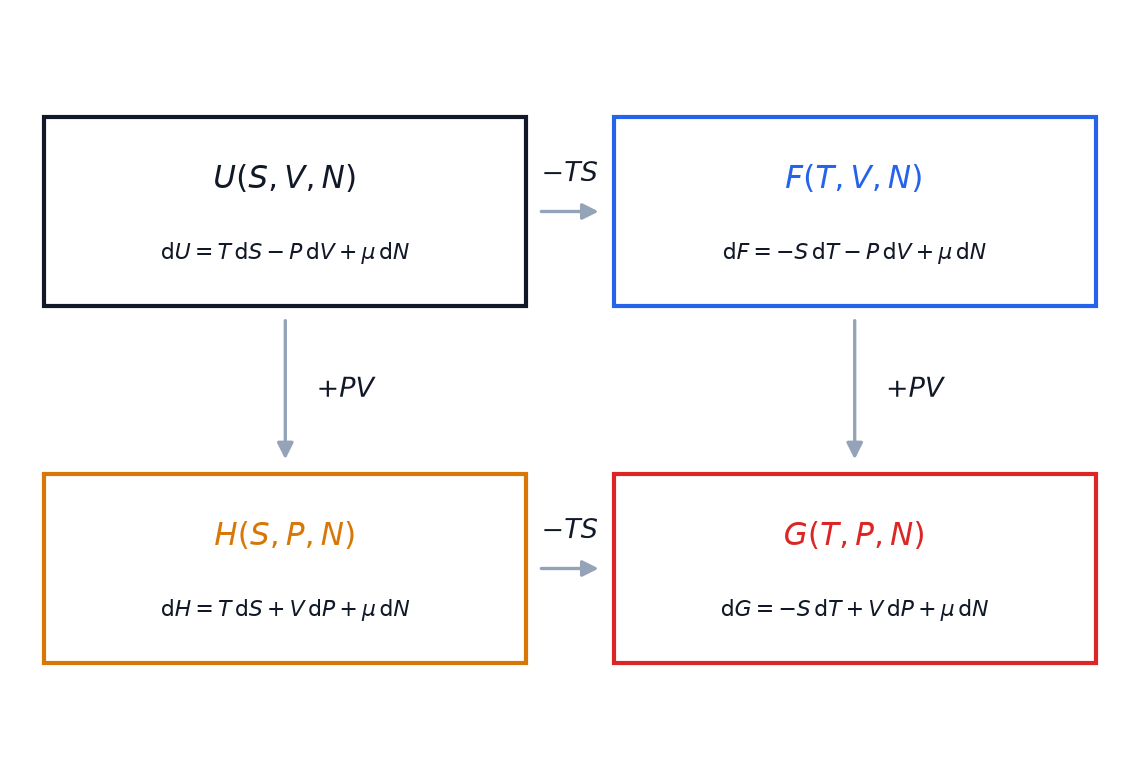
The four energy potentials. Moving right subtracts and trades entropy for temperature; moving down adds and trades volume for pressure. Each box gives the potential’s natural variables and its differential.
Each of the three is as complete as was, provided it is written in its own natural variables: is a fundamental relation, written as a function of anything else is not. The ideal gas shows the difference. Written in terms of the thermal wavelength , Sackur–Tetrode gives
Its volume slope is , which is : the equation of state that could not supply is back.
One more identity. Module 09’s Euler relation, , rearranges into
The Gibbs free energy of a one-component system is its chemical potential times the number of particles. Module 13 starts from this line.
Step 4: the Maxwell relations
Each potential is a function of state, so its differential is exact, and module 05’s test applies: the mixed second derivatives agree. For at fixed , the coefficients of and are and , so
The same step on the other three differentials gives the other three relations.
There is no need to memorise these. Each one is read off a differential in a line: the variables held fixed tell you which potential, and the coefficients tell you what to differentiate. Module 05’s advanced section promised that exactness would stop looking like an abstraction; this is the payoff. Work and heat were inexact, and nothing followed from them. The potentials are exact, and every pair of their slopes is tied together.
The relation from is the remarkable one. Its left-hand side is how entropy changes with volume — something no instrument reads. Its right-hand side is how pressure changes with temperature in a sealed vessel — a pressure gauge and a thermometer. Step 7 puts it to work.
Step 5: what is minimised when a bath holds the temperature
Module 09’s maximum principle belongs to an isolated system. Put the system in contact with a reservoir at temperature and it is not isolated any more — but system plus reservoir is, and module 07’s second law applies to the pair:
The reservoir changes only by exchanging heat at its fixed temperature. If flows into the system, the reservoir loses entropy :
Now hold the system’s volume fixed, so no work is done on it, and by the first law. Substituting,
At fixed the left side is exactly .
Let the piston move against the atmosphere as well, at pressure . Then the work done on the system is , the heat is , and the same three lines give .
This is the answer to the puzzle. A chemist’s reactions run on a bench, at the room’s temperature and the atmosphere’s pressure, so the chemist tabulates . A physicist’s crystal sits in a cryostat at fixed temperature and fixed volume, so the physicist minimises . Nobody is disagreeing: each is quoting the potential that decides what happens under their own constraints.
The energy can rise. Nothing in the argument asks to fall. At fixed and the requirement is only that . If the system’s entropy rises by a lot, its energy is free to rise too, with the reservoir supplying the difference. The second animation shows exactly this: dense argon on both sides of a piston, its energy rising by as the dense side spreads out and its atoms’ mutual attraction weakens, while falls by . The argon ends at the largest energy the piston can reach. “Systems minimise their energy” is true for a ball rolling in a bowl with friction, and false for anything whose entropy matters.
What is free about free energy. Let the system do work as well, with the reservoir still holding its temperature. The first law now has a work term, , and the second law still says , so . Then
That is what “free” means: available as work at fixed temperature. It is not a quantity of energy stored inside anything. Two cylinders of argon at the same temperature have the same internal energy, and the compressed one can deliver more work, because its entropy is lower and the reservoir will supply heat as it expands. At constant pressure the same argument, with the work split into the spent pushing back the atmosphere and everything else, gives the chemist’s version: the work other than that can be drawn from a process at fixed and is at most .
Step 6: enthalpy keeps the books on heat
At constant pressure, with no work other than , the first law reads
and moving the last term across gives
The heat absorbed at constant pressure is the change in enthalpy. This is why chemists tabulate for reactions, and why module 06’s constant-pressure heat capacity is its slope, . It is also why is so often called “heat content” — a name that is exactly as misleading as module 05’s “heat stored in a body”. is a function of state. Heat is not, and the two coincide only under the two conditions in the derivation.
Break either one and they part. With work other than , say electrical work done on the system, the first law gains a term and
Splitting a mole of liquid water into hydrogen and oxygen at and has . Run reversibly in an electrolysis cell, the electrical work is — the reason a cell needs at least — and the other arrives as heat drawn from the surroundings. is the same whatever the route; the heat is not.
Throttling. Push a gas steadily through a porous plug in an insulated pipe. Follow one parcel of particles across. The gas behind it pushes it through, doing work on it; on the far side it pushes the gas ahead, doing work ; no heat crosses the insulation. So
The enthalpy is the same on both sides of the plug; nothing else has to be. For an ideal gas, depends only on temperature, so the temperature is unchanged too. For a real gas it is not: the van der Waals argon of the laboratory, throttled from 50 to at , cools by — while its internal energy rises by per mole. This is the Joule–Thomson effect, and it is how air is liquefied.
Step 7: entropy from a pressure gauge
Now the showpiece. Integrate the Maxwell relation from along an isotherm:
The right-hand side is a laboratory procedure. At each of several volumes, seal the gas and record its pressure at several temperatures; the slope of each line is ; add the slopes up across the volumes. No step reads an entropy.
For an ideal gas , and the integral gives
module 09’s free-expansion entropy, now reached a fourth way. For a van der Waals gas the pressure is
and at fixed volume the attraction term does not depend on temperature, so it drops out of the slope entirely:
The atoms’ size shows up in the entropy and their attraction does not. The laboratory makes both measurements from simulated noisy gauge readings.
A rubber band. Stretching a band by against its tension does work on it, so its fundamental relation is , its free energy obeys , and its Maxwell relation is
Clamp a band at a fixed length, hang it from a force gauge, and warm it: the tension rises, by about per kelvin in the laboratory’s data. So stretching the band at fixed temperature lowers its entropy. The long molecules inside are pulled out of their tangled, many-arrangement states into fewer, straighter ones — module 08’s entropic force, measured with a spring balance.
The rest of prediction 3 follows from that one sign. Stretched fast, the band has no time to lose heat, so its entropy stays fixed; the arrangements the chains lose must be made up somewhere, and they are made up by faster jiggling — the band warms your lip. And a band holding a weight pulls harder when warmed, so it lifts the weight: it contracts on heating, the opposite of almost every other material.
Verify computationally
The derivation is a chain of exact statements. The laboratory checks each link numerically, on the ideal gas, the Einstein solid and the van der Waals gas, and includes a test built to fail. Each check is also a test in the project’s suite.
1. The potentials from the relation match their closed forms. Located on the entropy surface by bisection, with no formula for any potential supplied, agrees with the Sackur–Tetrode closed form of step 3 and with the Einstein solid’s to better than one part in 109. equals module 09’s chemical potential, equals , and differentiating each potential numerically returns its conjugate variables, all to one part in 106 or better.
2. The Legendre transform, numerically. On a grid of 104 values of , taking slopes of and subtracting gives from 25 to within of the closed form. On coarse grids the transform shows a property worth knowing:
3. A Maxwell relation holds — and can fail. For the van der Waals relation, the relative gap between and falls from to as the step shrinks from 0.04 to 0.005, at an observed order of exactly 2. That is the whole of what remains: the truncation error of the differences, down to a rounding floor near 10-7. Pair the ideal gas’s entropy with the van der Waals pressure instead and the gap sits at — 0.119 at — and does not move when the step is refined tenfold.
4. Free energy falls while energy rises. The piston run of the second animation, stepped through 201 constrained equilibria:
falls at every step and the total entropy rises at every step, by in all. That total equals by construction, because the bath’s entropy is booked from the first law, so the agreement is bookkeeping rather than a test; what the run shows is that both move one way only, and that climbs while they do. The piston stops where the pressures agree, at on both sides — which for one gas at one temperature means equal densities. The same run on ideal argon changes the energy by nothing and lowers by . Neither gas minimised its energy.
5. Enthalpy keeps the books. Module 06’s isobaric heat, , and the enthalpy difference between the two end states located on the entropy surface agree to one part in 108. Throttling from 50 to leaves ideal argon at and cools van der Waals argon to , with unchanged in both. For a small drop at the cooling is per bar, against 0.3687 from the textbook formula for a dilute van der Waals gas.
6. Entropy from a pressure gauge. A simulated gauge that reads pressure to is read at nine temperatures and nine volumes from 1 to , for 1021 atoms. The reconstructed entropy change is
against : an uncertainty of , and 1.3 error bars from the truth. Over twenty independent runs the mean lands from , and the runs scatter by , against the each run reports about itself — the error bar is honest. For one mole of dense van der Waals argon doubling from 0.2 to , the gauge gives , matching to six digits, and more than the ideal gas’s 5.763.
7. The rubber band. A straight line through all thirteen readings of the reference dataset gives , so . At the band pulls with , of which is entropic: the energy of stretched bonds accounts for about of the tension.
Transfer the idea
Looking back:
Module 05 separated exact differentials from inexact ones and warned that the distinction would pay off. Heat and work, being inexact, have no Maxwell relations. The potentials, being exact, have four, and one of them measures entropy.
Module 06’s constant-pressure heat and are now and its slope. The bookkeeping was right; it now has a function of state behind it.
Module 07’s second law, applied to a system and its reservoir together, is the whole of step 5. The minimum principles are not new laws.
Module 08 ended with rubber elasticity as an entropic force. The rubber band’s Maxwell relation is that claim with a number on it.
Module 09’s concavity is exactly the condition that makes the Legendre transform safe, and its Euler relation becomes .
Looking ahead:
Modules 11 and 12 meet a second time, from counting. A system in contact with a bath has a partition function , and . Module 12 checks that this and the one on this page are the same function for the Einstein solid.
Module 13 opens with and .
Module 14 takes a relation with a dent — the advanced section below — and shows that the fold in its is two phases coexisting.
And sideways:
Chemistry tables of and are this module institutionalised. Hess’s law — that the heat of a reaction does not depend on the steps it is split into — is the statement that is a difference of a function of state, and it holds at constant pressure with no other work. A negative at the bench’s temperature and pressure means a reaction can run; it says nothing about how fast.
Steam tables list enthalpy because a turbine or a compressor is a steady-flow device, and the parcel argument of step 6 — with the shaft’s work added — is exactly how engineers do their energy books.
Worked examples
Try each one before opening its solution.
Worked example 1 — heating at constant pressure. One mole of argon is heated at a constant from 300 to . Find , the work done on the gas, the heat absorbed and .
Solution
Worked example 2 — the most work at fixed temperature. One mole of an ideal gas at expands from 10 to against a piston, in contact with a bath at . What is the most work it can deliver, and where does the energy come from?
Solution
At fixed temperature the work it can deliver is at most . Only the volume term of changes:
The gas’s energy does not change at all, so every one of those joules came from the bath, as heat . The gas is a converter, not a store. If it expanded freely into a vacuum instead, it would reach the same final state, deliver nothing, and produce of entropy — module 09’s lost work.
Worked example 3 — entropy from a gauge, real gas. One mole of argon doubles its volume from 0.5 to at fixed temperature. Treating it as a van der Waals gas with , find its entropy change and compare it with the ideal gas’s.
Solution
The Maxwell relation from gives , and for the van der Waals gas that slope is per mole. Integrating,
against for an ideal gas. The excluded volume makes the doubling a larger fractional gain in the room each atom can actually use. The attraction constant never appears: it lowers the pressure by the same amount at every temperature.
Worked example 4 — the rubber band’s entropy. The laboratory’s band, clamped at twice its slack length, has a tension of at , rising at per kelvin. How much heat does it give off if stretched a further centimetre, slowly, at ? What share of its tension is entropic?
Solution
By the Maxwell relation, . Treating that slope as constant over the extra centimetre, the heat taken in reversibly is
so the band gives off to its surroundings. The entropic part of the tension is , which is of the .
Worked example 5 — splitting water. For at and , and . Two electrons pass through the cell per molecule. What is the smallest voltage that can split water, and what heat flows when the cell runs reversibly? At what voltage does it need no heat at all?
Solution
At fixed and the electrical work done on the system is at least . Two moles of electrons carry a charge , with the Faraday constant, so
Run reversibly, gives drawn in from the surroundings. Raise the voltage and more of comes in as electrical work; at
the heat is zero. was the same throughout, and the heat was anything from in to heat given off: enthalpy is not the heat of the process.
Worked example 6 — which potential? For each situation, name the quantity that is extremal or conserved: (a) a sealed steel bomb in a water bath; (b) a reaction in an open flask on a bench; (c) a gas leaking through a crack in an insulated pipe; (d) a thermos of coffee, sealed.
Solution
(a) Fixed and : falls to a minimum. (b) Fixed and : falls to a minimum. (c) A steady throttle: is the same on both sides. (d) An isolated system, near enough: rises to a maximum, which is module 09’s principle and the one all the others were derived from.
Check your understanding
A reaction runs in an open beaker on a laboratory bench, at room temperature and atmospheric pressure, until it stops. Which quantity of the beaker’s contents has reached its minimum?
A. The Gibbs free energy G = U - TS + PV. B. The internal energy U. C. The Helmholtz free energy F = U - TS. D. The enthalpy H = U + PV.
Check your answer
Correct answer: A — The Gibbs free energy G = U - TS + PV.
A. Right. The room holds the temperature and the atmosphere holds the pressure, and at fixed T and P the second law, applied to the contents plus their surroundings, becomes dG <= 0. G is the potential whose natural variables are the two things the bench controls.
B. U is minimised only at fixed entropy and volume, and nothing on a bench holds the entropy fixed. A reaction that absorbs heat from the room raises U and still runs.
C. F is the right potential when the temperature and the VOLUME are fixed, as in a sealed rigid vessel. An open beaker is free to expand against the atmosphere, so the volume is not fixed but the pressure is.
D. H is minimised at fixed entropy and pressure, and conserved across a throttle. At fixed pressure it keeps the books on heat, which is why chemists tabulate it, but the temperature-controlled bench is decided by G.
A rigid box in contact with a heat bath at 300 K holds a dense gas on both sides of a piston. The piston is released, drifts and stops. Afterwards the gas’s internal energy is found to have RISEN by 282 J. What is true?
A. That is possible. The gas’s free energy fell, and the gas’s entropy rose by more than the bath’s fell. B. That is impossible. Systems left to themselves always move toward the lowest energy available. C. That is possible only if something outside did work on the gas. D. That is possible, but then the total entropy of gas and bath must have fallen.
Check your answer
Correct answer: A — That is possible. The gas’s free energy fell, and the gas’s entropy rose by more than the bath’s fell.
A. Right. At fixed T and V the second law, applied to gas plus bath, says F must fall: Delta S_total = -Delta F / T >= 0. The bath supplied the 282 J and lost 282/300 J/K of entropy, but the gas, spreading out, gained far more. Nothing requires U to fall; for a gas whose atoms attract, U rises as they move apart.
B. This is the minimum-energy misconception. It holds for an isolated mechanical system with friction, not for a system in contact with a heat bath. There what falls is F = U - TS; the bath can pay for a rise in U so long as the total entropy of gas and bath still rises.
C. The box is rigid and nothing outside pushed on anything. The 282 J arrived as heat from the bath, drawn in because the gas’s rearrangement raised the total entropy.
D. A spontaneous change cannot lower the total entropy. Here it rose, by -Delta F / T: the gas’s entropy gain outweighed the bath’s loss of 282/300 J/K.
A gas flows steadily through a porous plug in an insulated pipe, from high pressure to low. Which of these is the same on both sides of the plug, for any gas?
A. The enthalpy H = U + PV of each parcel of gas. B. The internal energy U, because energy is conserved. C. The temperature, because the pipe is insulated. D. The entropy, because no heat flows.
Check your answer
Correct answer: A — The enthalpy H = U + PV of each parcel of gas.
A. Right. The gas behind a parcel pushes it in, doing work P_in V_in on it; the parcel pushes the gas ahead, doing P_out V_out; no heat crosses the insulation. So U_out - U_in = P_in V_in - P_out V_out, which says H_out = H_in.
B. Energy is conserved, but the parcel’s own energy is not, because work is done on it at the inlet and by it at the outlet, and the two are unequal. A van der Waals gas throttled from 50 bar to 1 bar at 300 K gains about 50 J per mole of internal energy while it cools.
C. Only an ideal gas, whose enthalpy depends on T alone, leaves at the temperature it entered. Real gases below their inversion temperature cool, and this is how air is liquefied.
D. Throttling is irreversible: the gas expands through the plug without doing useful work, and its entropy rises. No heat flows, but entropy is produced.
A gauge and a thermometer on 0.100 mol of a gas show that, at every volume between V and 2V, the pressure rises with temperature at fixed volume as (dP/dT)_V = nR/V, with R = 8.314 J/(mol K). What is the entropy change when the gas doubles its volume at fixed temperature, in J/K?
Check your answer
Correct answer: 0.5763 (± 0.01)
The Maxwell relation from F turns the measured slope into an entropy slope: (dS/dV)_T = (dP/dT)_V = nR/V. Integrating from V to 2V gives Delta S = nR ln 2 = 0.100 x 8.314 x 0.6931 = 0.576 J/K. Nothing in the measurement read an entropy. If you got 0.831 you left out the ln 2; if you got zero you assumed the isothermal entropy change of a gas vanishes because its energy does not change.
Starting from dG = -S dT + V dP at fixed N, which Maxwell relation follows?
A. (dS/dP)_T = -(dV/dT)_P B. (dS/dP)_T = (dV/dT)_P C. (dS/dV)_T = (dP/dT)_V D. (dT/dP)_S = (dV/dS)_P
Check your answer
Correct answer: A — (dS/dP)_T = -(dV/dT)_P
A. Right. The coefficients of dT and dP are -S and V, and the mixed partials of G agree: d(-S)/dP at fixed T equals dV/dT at fixed P. Moving the minus sign across gives the relation. For an ideal gas it says the entropy falls as -N k_B / P when the gas is squeezed at fixed temperature.
B. The sign is lost. The coefficient of dT is -S, not S, and differentiating it keeps the minus. Check on an ideal gas: squeezing at fixed T lowers S, while heating at fixed P raises V, so the two sides must have opposite signs.
C. This is a true Maxwell relation, but it comes from F, whose natural variables are T and V. G’s natural variables are T and P, so its relation involves derivatives with respect to P at fixed T and to T at fixed P.
D. This is the Maxwell relation from H, whose natural variables are S and P. The variables held fixed tell you which potential a relation came from.
Two cylinders each hold one mole of argon at 300 K, one in 1 L and the other in 10 L. Their internal energies are equal. In a room at 300 K, which can deliver more work, and by how much?
A. The 1 L cylinder, by up to RT ln 10, about 5.7 kJ, although the two hold the same energy. B. Neither. They hold the same internal energy, so they hold the same free energy to spend. C. The 10 L cylinder, because it has more volume to push against a piston. D. It cannot be decided without knowing what the cylinders are made of.
Check your answer
Correct answer: A — The 1 L cylinder, by up to RT ln 10, about 5.7 kJ, although the two hold the same energy.
A. Right. At fixed temperature the most work a system can deliver is the fall in its free energy, and F = U - TS differs between the two by T times their entropy difference, RT ln 10. The energy it delivers is drawn from the room as heat while the gas expands; the gas’s own energy never changes.
B. This treats free energy as a kind of energy stored inside the gas. It is not: F = U - TS depends on the entropy too, and the compressed gas has less. Equal energies, unequal free energies, unequal work.
C. The 10 L gas is at a tenth of the pressure. The work a gas can deliver on the way to equilibrium with its surroundings comes from its free energy, which is higher, not lower, for the compressed one.
D. The cylinders only hold the gas. The work available at 300 K depends on the gas’s state through F, and both states are fully specified.
In two or three sentences: U(S) at fixed V and N is replaced by F(T), the intercept of its tangent line as a function of the tangent’s slope. Why does F(T) know everything U(S) knew?
Check your answer
Because U(S) is strictly convex, each slope T touches the curve at exactly one point, so the family of tangent lines -- one for each T, each fixed by its slope T and its intercept F(T) -- is in one-to-one correspondence with the points of the curve. The curve is the envelope of that family, so it can be rebuilt from F(T) alone: S = -dF/dT gives the point each tangent touches, and U = F + TS its height. A careful answer names convexity as the condition; if two points shared a slope, the transform could not say which one it meant.
A gas is held at a constant pressure of 1.00e5 Pa. Its internal energy rises by 1247 J and its volume by 8.31e-3 m^3. Part of the energy arrived as 500 J of electrical work, from a heater wire counted as part of the system. How much heat Q crossed the boundary, in joules?
Check your answer
Correct answer: 1578 (± 5)
The enthalpy change is Delta H = Delta U + P Delta V = 1247 + 831 = 2078 J. With only P dV work, Q would equal Delta H; here 500 J of electrical work was also done on the system, so Q = Delta H - W_elec = 2078 - 500 = 1578 J. If you answered 2078 J, you took Delta H to be the heat: that holds only at constant pressure with no work other than P dV.
Stretch a rubber band quickly and touch it to your lip: it feels warm. Before the laboratory’s rubber-band analysis, predict (a) the sign of (dS/dL)_T, (b) whether the tension at fixed length rises or falls as the band warms, and (c) what a band with a weight hanging from it does when warmed with a hair dryer.
Check your answer
(a) Negative: stretching at fixed temperature lowers the band’s entropy, because the long molecules are pulled out of their tangled arrangements. The lip test says so directly -- stretched fast, with no time for heat to leave, the entropy stays fixed, so the lost arrangements must be made up by faster jiggling, which is a higher temperature. (b) The Maxwell relation (dS/dL)_T = -(df/dT)_L turns a negative entropy slope into a positive temperature slope: the tension rises as the band warms, about 5.8 mN/K in the laboratory’s data. (c) It contracts, lifting the weight -- the opposite of nearly every other material. If you predicted expansion, you reasoned from ordinary solids, whose tension comes from bond energies; about 85 percent of a rubber band’s comes from entropy.
One mole of an ideal gas at 300 K expands against a piston from 10 L to 20 L, in contact with a bath at 300 K throughout. What is the most work it can deliver?
A. RT ln 2, about 1.73 kJ -- the fall in its free energy. B. Zero, because the gas’s internal energy does not change. C. P V at the start, about 2.49 kJ. D. It is unlimited, because the bath can supply any amount of heat.
Check your answer
Correct answer: A — RT ln 2, about 1.73 kJ -- the fall in its free energy.
A. Right. At fixed temperature the work done ON the system is at least Delta F, so the work it can deliver is at most -Delta F = RT ln 2. It is reached by a slow, reversible expansion, and every joule of it comes from heat drawn from the bath.
B. The gas’s energy is unchanged, but the bath supplies heat as the gas expands. What limits the work is the free energy, not the internal energy.
C. That would need the pressure to stay at its starting value for the whole expansion. At fixed temperature the pressure falls as the volume grows, and the area under the isotherm is RT ln 2.
D. The bath can supply heat, but the second law limits how much of it turns into work while only this gas changes state: the limit is -Delta F.
Suppose a substance’s F(V), at some fixed temperature, had a stretch where it curved the wrong way, so that the slope dF/dV = -P was not monotone there. What happens to its Legendre transform G(P)?
A. Several volumes share one pressure, so G(P) folds back on itself and cannot say which state it means. B. Nothing changes; the Legendre transform works for any smooth function. C. G(P) becomes negative. D. The transform stops existing, because the derivative becomes undefined.
Check your answer
Correct answer: A — Several volumes share one pressure, so G(P) folds back on itself and cannot say which state it means.
A. Right. A slope names a single point only where the curve is strictly convex. Across the dent, three tangents share each slope, and the transform traces three branches over one range of pressures. The information is not lost; the ability to pick one state is. Module 14 resolves the fold, and it turns out to be two phases coexisting.
B. It can be computed for any smooth function, but it loses its inverse without convexity: the slope no longer names a unique point, so F(V) cannot be rebuilt from G(P).
C. The sign of G is not what goes wrong; G is usually negative for a gas anyway. What goes wrong is that one pressure no longer picks out one state.
D. The derivative is perfectly defined across the dent; it just rises and falls instead of rising steadily. The transform exists, but it is multivalued.
For a monatomic ideal gas U = (3/2) N k_B T. Why is U written as a function of T and V not as complete a description as U written as a function of S and V?
A. It does not depend on V at all, so it cannot give the pressure, which U(S, V) gives as -dU/dV. B. It is complete; T and V are just a more convenient pair than S and V. C. It is incomplete only because it ignores the chemical potential. D. It is incomplete because T cannot be measured directly.
Check your answer
Correct answer: A — It does not depend on V at all, so it cannot give the pressure, which U(S, V) gives as -dU/dV.
A. Right. Substituting the slope T for S throws away information: every gas whose energy is (3/2) N k_B T has the same U(T, V), whatever its pressure. The Legendre transform to F = U - TS keeps it, because F’s volume slope is -P.
B. Convenient, yes, but not complete: from U(T, V) = (3/2) N k_B T no amount of differentiation recovers the pressure. The complete function of T and V is F, not U.
C. Holding N fixed, the chemical potential plays no part. The trouble is already there at fixed N: U(T, V) cannot give P.
D. T is the easiest of the variables to measure. The problem is not measurement but information: the function U(T, V) has lost what the function U(S, V) contained.
Exam-style problems for this module — the ones worth doing with a pen — are collected in the problem set.
Explain it in your own words
Answer in a few sentences each.
A chemist asks why physicists keep writing where every chemistry table lists . Explain the difference without calling either choice wrong.
What exactly is “free” in free energy, and what is not? Use the two argon cylinders of prediction 2.
Explain to a laboratory technician, without the word “entropy” in your first sentence, why measuring how a sealed gas’s pressure rises with temperature tells you how its entropy grows with volume.
Why does substituting for in lose information, while the Legendre transform to does not?
A student says that because the piston’s argon ended at higher energy, “energy must have been created”. Find the flaw.
Advanced: a mnemonic, a second family, and a dent
The thermodynamic square. Generations of students have memorised the four Maxwell relations with a square whose corners carry potentials and whose sides carry variables, read off by walking around its edges with sign rules for each direction. It works, and the course does not use it. Every relation on this page was read off a differential in one line, and checked numerically in the laboratory. A mnemonic stores four facts; the method produces any number of them, including the rubber band’s, which no square contains.
Massieu functions. The Legendre transforms of this module were all taken of the energy . The entropy can be transformed just as well, and its natural slope is . Trading for gives
a Massieu function, whose natural variable is . It carries the same information as , but its form is the one module 11 finds when it counts states: the logarithm of the partition function, , is exactly .
A relation with a dent. Every transform on this page assumed strict convexity. Below its critical temperature, about for argon, the van der Waals does not have it: over a range of volumes it curves the wrong way, and the pressure there rises as the gas is compressed — the unstable stretch of module 02’s loop.
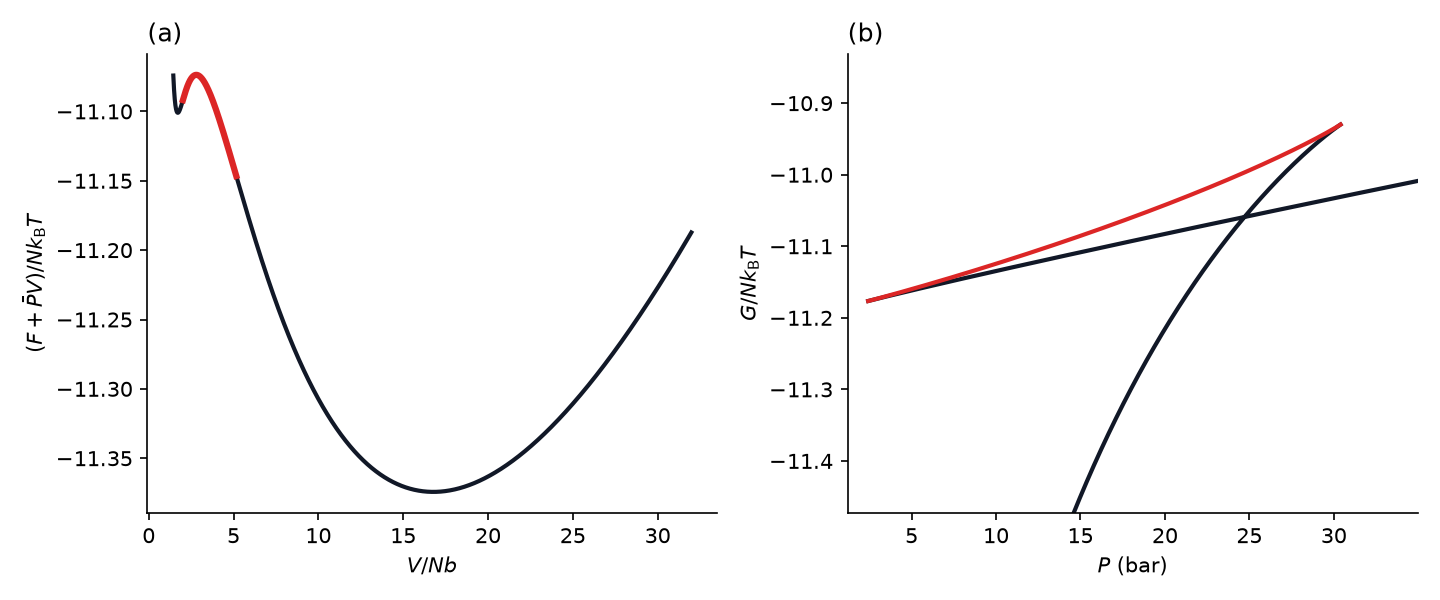
The van der Waals of argon at . (a) against volume, where is a constant pressure chosen to make the dent visible — adding a straight line changes no curvature. The red stretch is where curves the wrong way. (b) Each tangent to has slope and meets the axis at . The tangents from the two healthy stretches give the two black branches; those from the dent give the red one, joining the branches’ ends in two sharp points. Between about 2 and , three values of share each pressure.
The transform has not lost the dent: the red branch is there. What it has lost is the ability to
say which of three states a given pressure means, and so the laboratory’s legendre_transform
refuses the calculation while tangent_intercepts draws the fold. The two black branches cross.
Past that crossing, the branch with the lower is the one the minimum principle of step 5
chooses — and a real substance, at that pressure, does something the smooth curve cannot: it
splits into liquid and vapour. Module 14 begins at that crossing.