The second law and heat engines
The puzzle: the ocean is enormous and useless
The Atlantic holds something like of thermal energy. A ship that cooled the water it passed through by a single kelvin, and turned that energy into forward motion, would cross the ocean on the ocean itself and arrive with the sea imperceptibly cooler. No fuel, no emissions, nothing consumed that anyone would miss.
Nothing in the first law forbids this. Energy would be conserved exactly: heat leaves the water, work appears at the propeller, the books balance to the last joule. The engine is not a perpetual-motion machine in the old sense — it is not creating energy, only borrowing some that is already there and unimaginably abundant.
And it cannot be built. Not “has not been built yet”, and not “is very hard to build”: there is a theorem against it, and the theorem is what this module is about.
The answer will not mention efficiency, engineering, or friction. It will turn out that a heat engine needs two temperatures, that having only one is the entire defect, and that this single requirement fixes the best possible performance of every engine that will ever be built — from a number that knows nothing about what the engine is made of.
Predict before you calculate
Commit to an answer for each of these before reading on. Write them down.
An engine takes in of heat from a furnace each cycle and delivers of work. Where is the other , and could a better design recover some of it?
Two engines run between the same furnace and the same river. One uses steam, the other helium. Which can be made more efficient?
A refrigerator moves of heat out of its cold interior for every of electricity it draws. Is something wrong with that number?
Your kitchen refrigerator lowers the entropy of the food inside it. Does it violate the second law?
A power station’s steam is at and its cooling river at . Estimate the best efficiency it could possibly have. Now guess what it actually achieves.
A process is carried out infinitely slowly, so that everything is in equilibrium at every instant. Is it therefore reversible — could it be undone leaving no trace at all?
Explore the model
A heat engine is a working substance taken around a closed loop — back to exactly the state it started in — while touching a hot reservoir and a cold one. Closure is not a detail. It is what makes the internal energy change vanish over a cycle, so that every joule of work delivered has to have arrived as heat, and it is why the engine cannot simply keep some energy back and call it output.
Every machine in this module is drawn the same way:
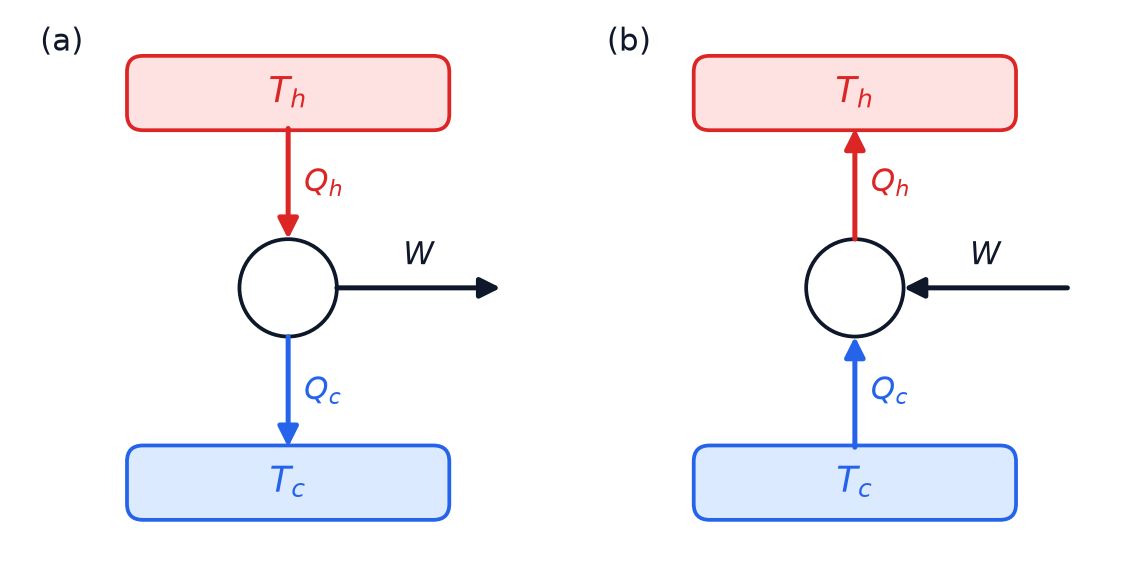
Reservoirs are the long bars — red at , blue at — and the circle is the working substance, which goes round a closed cycle. (a) An engine: heat in from the hot side, work out, heat down to the cold side. (b) The same machine run backwards: work in, heat lifted out of the cold side and delivered to the hot one. It is a refrigerator if what you want is the cold side, and a heat pump if what you want is the hot side. The labels are sizes; the arrows say which way the energy goes.
Here is the Carnot cycle running, with its energy ledger filling in beside it.
The Carnot cycle in the – plane: isothermal expansion in contact with the hot reservoir (red), adiabatic expansion (grey), isothermal compression against the cold reservoir (blue), adiabatic compression back to the start (grey). The shading appears only on the closing stroke, because the area is the work delivered only once the loop is actually closed.
Beside it, three running totals: heat drawn from the hot reservoir, net work delivered so far, and heat dumped into the cold one. Watch the middle bar overshoot — the two expansions deliver far more work than the cycle nets, and the two compressions hand most of it back. What is left when the loop closes is the enclosed area, and by then the third bar has risen too. It never returns to zero, and no rearrangement of the other strokes can make it.
Now watch what happens when the engine is asked to run between reservoirs whose temperatures get closer together, and when its thermal contact is made deliberately sloppy:
Every point is one engine, built with a randomly chosen size, expansion ratio and quality of thermal contact, plotted against the curve . Engines with perfect contact (dark) sit exactly on the curve; every degree of temperature gap they need in order to move heat at a finite rate (lighter) pushes them below it. Nothing ever lands above. The dashed curve is the maximum-power efficiency , which is where real plants live; the advanced section derives it.
Run the laboratory now, then come back. Four things are worth doing before you read on:
Try to design an engine that beats . Change the gas, the size, the shape of the loop. Watch the bound refuse to move.
Shrink the temperature gap between the reservoirs and watch the efficiency collapse.
Run the cycle backwards and read off what the machine has become.
Put a free expansion into a cycle and watch the loop sum of heat over reservoir temperature turn negative. What that sum is will be the last idea of the derivation.
Derive the result
System and boundary. The working substance, taken around a closed cycle. The reservoirs are outside it, and we keep separate books for what they lose and gain.
Independent variables and constraint. The two reservoir temperatures and , which nothing in the cycle changes, and the gas’s own volume and temperature, which the cycle drives round the loop; every other state quantity follows from those through the equation of state. The one constraint is closure: the gas ends each cycle in the state it began, so its internal energy — and, once it has been defined, its entropy — returns to its starting value. The argument is thermodynamic throughout: no microstate is counted anywhere in this section.
Sign convention. The course convention holds throughout, with positive into the system. Engines are conventionally rated by the work they deliver, and one clearly marked block below converts to it and converts back.
Route. The derivation runs in a straight line, and each step uses only the ones before it: the second law as two prohibitions; what “reversible” means and why friction and heat leaks are not; why an engine needs two reservoirs; Carnot’s theorem and the number it puts on every engine; and finally the Clausius inequality, which turns the whole story into a new function of state, the entropy.
What the second law actually says
Unlike the first law, the second law is not an equation. It is a statement about what cannot happen, and it comes in two historical forms that sound unrelated.
Both are empirical laws: they summarise that nobody has ever observed otherwise, and they are not derived from mechanics. Two words in them do all the work. Cyclic means the machine returns to its starting state, so that it can do the same thing again — a single expansion can convert heat entirely into work, and an isothermal expansion does exactly that, but it leaves the gas bigger, so it is not a cycle and cannot be repeated. Sole result means nothing else is left changed anywhere; a refrigerator moves heat from cold to hot every day, but not as its sole result, because it also consumes electricity.
That already answers the opening puzzle. The ocean-powered ship is a cyclic engine drawing heat from one reservoir and producing work with no other change — precisely the Kelvin statement’s forbidden machine. What the ship lacks is not efficiency but a second, colder reservoir to dump into.
The two statements are the same statement
They look like claims about different machines. They are not: each one can be used to build a violation of the other, so either both hold or neither does. The argument is easiest to follow as a picture.
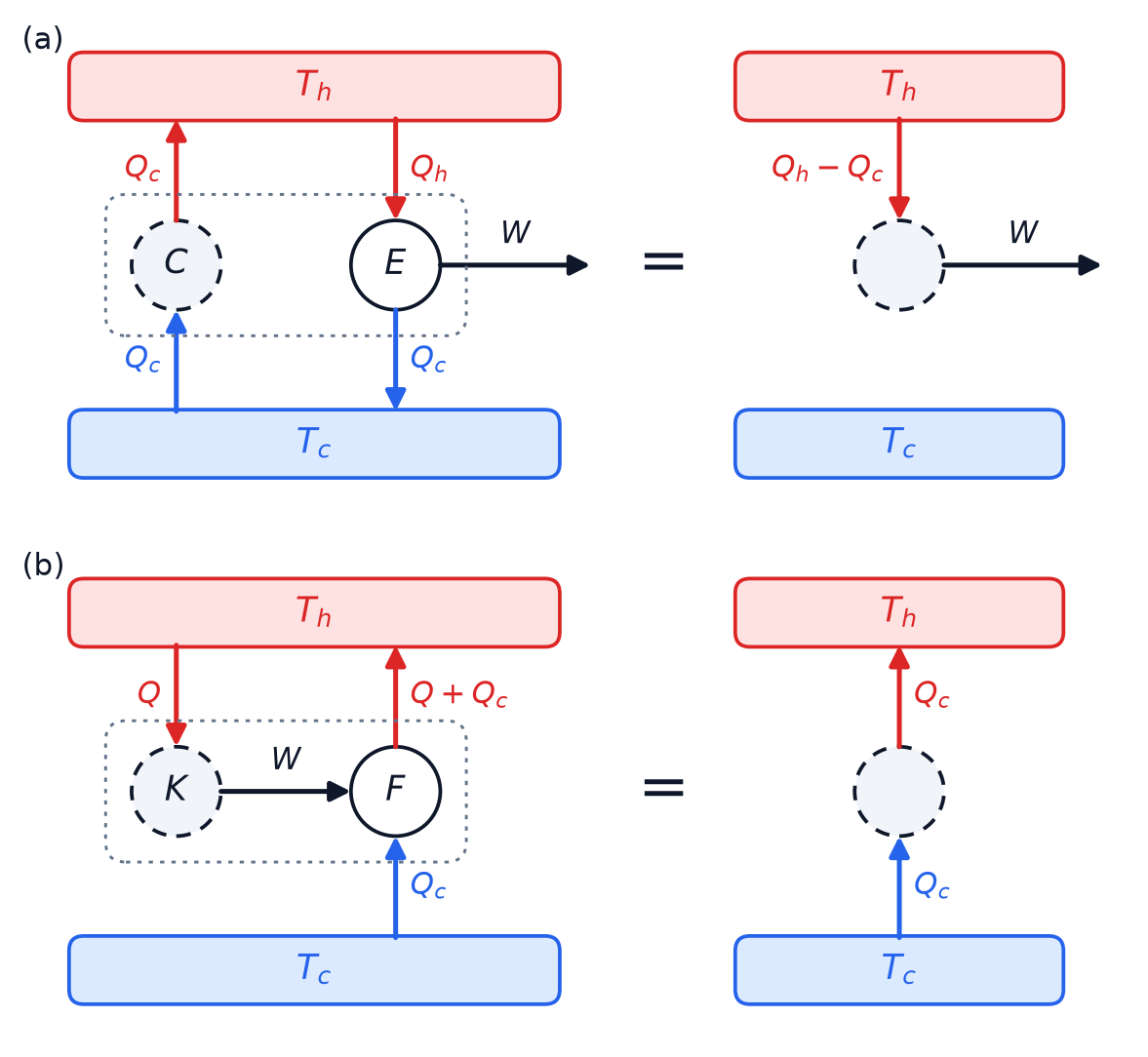
The equivalence, as two machines glued together. Dashed circles are the machines that cannot exist; the dotted outline marks the pair being read as a single machine. (a) A Clausius violator beside an ordinary engine sized to dump exactly the heat lifts: the cold reservoir nets nothing, and what remains takes from one reservoir and turns all of it into work — a Kelvin violator. (b) A Kelvin violator driving an ordinary refrigerator : no work leaves the pair, and climbs from cold to hot on its own — a Clausius violator.
Suppose Clausius fails — panel (a).
Some device moves heat from the cold body to the hot one with no other effect.
Run an ordinary engine alongside it: the engine draws from the hot body, delivers work , and is sized to dump exactly into the cold one.
Now look at the pair as a single machine. The cold body received from the engine and gave up to the magic device — unchanged.
What is left is that the hot body lost and work appeared. A single reservoir, fully converted into work: Kelvin fails too.
Suppose Kelvin fails — panel (b).
Some device draws from the hot body and turns all of it into work.
Feed that work to an ordinary refrigerator , which uses it to move from the cold body to the hot one.
Together: the cold body lost ; the hot body gave up and received , for a net gain of ; and no work is left over.
Heat has moved from cold to hot as the sole result: Clausius fails too.
Reversible and irreversible processes
Carnot’s theorem, coming next but one, compares every engine with a reversible one, so the word has to be sharp before it is used. Module 06 defined it; the second law is what gives the definition teeth.
In practice three conditions are needed together: the process is quasistatic, it involves no friction or other dissipation, and no heat crosses a finite temperature difference. Slowness delivers only the first. Here are the common ways a process fails, and in each case it is the second law that proves the failure is permanent: assume the process could be undone without trace, and a forbidden machine appears.
1. Heat crossing a finite temperature difference. Heat flows by conduction from a body at into one at . To undo it without trace, would have to go back from to with nothing else changing — exactly what the Clausius statement forbids. However slowly the heat leaks, the leak is irreversible, because slowness does not shrink the temperature gap it crosses.
2. Friction. A block slides to rest, and its kinetic energy ends up as heat in a table at temperature . Undoing it means taking that heat out of the table and returning all of it to the block as motion, with no other change: heat from a single reservoir converted entirely into work, which is the Kelvin statement’s forbidden result. Electrical resistance, magnetic hysteresis and viscous stirring are the same thing in different clothes — work turned into heat at one temperature.
3. Unrestrained expansion. A gas at temperature expands freely from into a vacuum until it fills . Suppose some device could return it to at the same temperature, leaving no other trace. Then let the gas expand again, this time reversibly, along the isotherm at in contact with a reservoir: it absorbs of heat and delivers the same amount of work. Return it with the device. The gas has gone round a cycle, one reservoir has lost heat, and exactly that much work has appeared: Kelvin again.
4. Mixing. Two different ideal gases sharing a box after a partition is removed behave as two independent free expansions, each gas spreading into the whole volume as if the other were absent. Unmixing them without trace would undo two free expansions at once, so mixing is irreversible for the same reason as (3). Module 08 looks at it again by counting.
Module 06 ended with an ordering it could measure but not explain. Letting a gas expand adiabatically to twice its volume, the slow route ended at , the route against a fixed load at and the free expansion at — and the slow route delivered the most work. Compressing to half the volume, the slow route ended at and slamming the piston at , at 3.4 times the cost. The Kelvin statement explains both at once.
Proof. Call the quasistatic endpoint , at temperature , and suppose some adiabatic route ended at the same volume but at . Close a cycle. First warm the gas at constant volume from to , using any single reservoir at a temperature and disconnecting it when the gas reaches . That warming is itself irreversible — heat crosses a gap — but nothing in the argument needs it not to be. The gas is now in state , so return it to along the quasistatic adiabat. Round the cycle , and the only heat that crossed was , absorbed from the one reservoir; so the gas did exactly that much net work on its surroundings. A cycle whose sole result turns one reservoir’s heat into work: Kelvin forbids it.
The argument never asked whether the volume went up or down, so it covers both of module 06’s experiments. For an adiabatic process , so the work done on the gas is
and a hotter endpoint means more work put in and less taken out. On the way out the quasistatic route delivers the most work any adiabatic expansion can; on the way in it costs the least any adiabatic compression can. Module 06’s numbers are the theorem being obeyed, and they could not have come out the other way round. The same statement will reappear below, in one line, in the language of entropy.
Why an engine needs two reservoirs, and why Carnot’s cycle has its shape
The Kelvin statement says a cyclic engine cannot run on one reservoir. For a gas you can see why, and the picture also shows what the second reservoir is for.
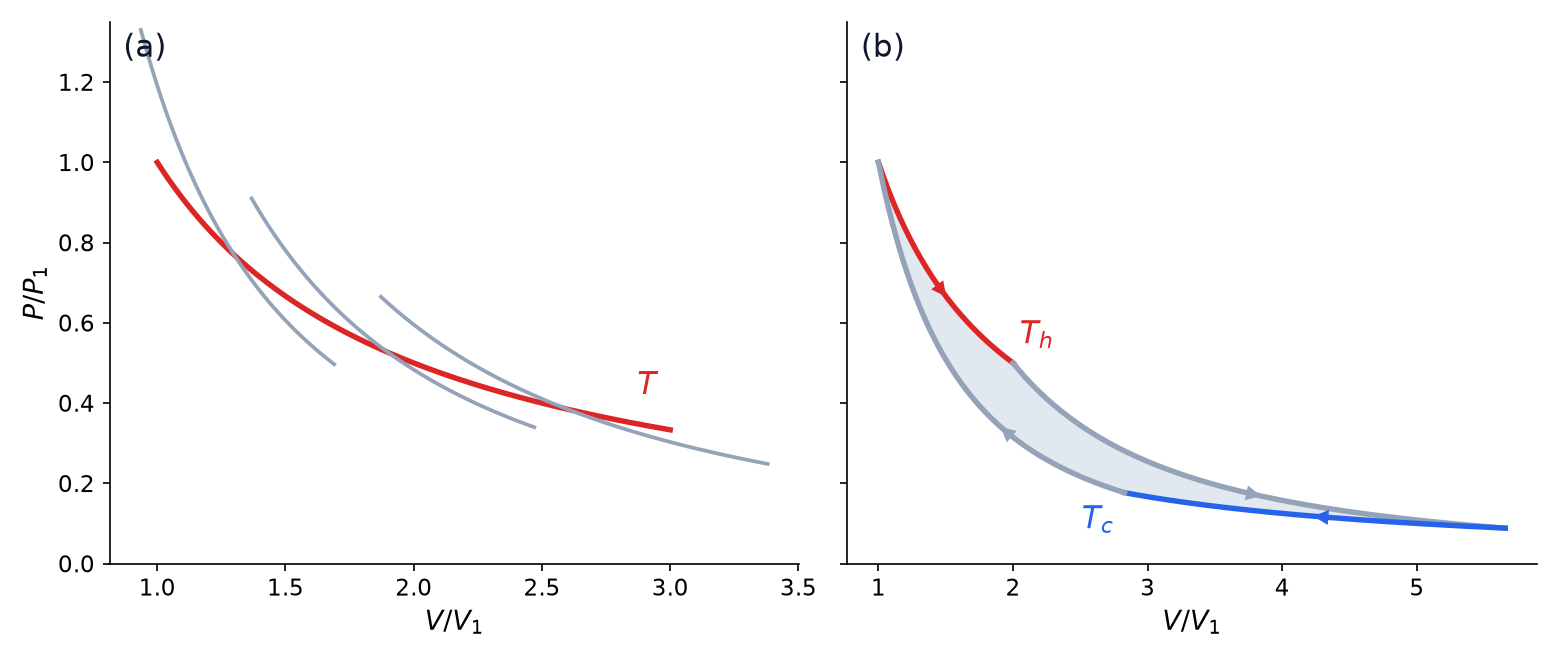
(a) One reservoir at temperature . Heat can move reversibly only along the red isotherm at ; every other stroke is an adiabat (grey), and each adiabat crosses the isotherm exactly once. No closed loop built from these pieces encloses any area. (b) Two reservoirs. Expansion on the hot isotherm, adiabatic cooling, compression on the cold isotherm at lower pressure, adiabatic warming back to the start. The shaded area between the outgoing and returning branches is the work delivered.
One reservoir. To stay reversible, the gas may exchange heat only while it is at the reservoir’s own temperature — any gap between them is source 1 above. So every stroke that moves heat lies on the one isotherm at , and every other stroke is adiabatic. But an adiabat, along which stays constant, is steeper than an isotherm, along which stays constant, so the two cross exactly once (panel a): leave the isotherm along an adiabat and the only way back onto it is the same adiabat. Every loop you can draw from these pieces retraces itself and encloses no area. No area, no work. Sloppy thermal contact does not rescue it — that is the Kelvin statement in general; the point here is only to see it happen to a gas.
Two reservoirs. Now add a colder reservoir at (panel b). The gas expands on the hot isotherm, absorbing heat and doing work; an adiabatic expansion cools it to with no heat flowing; it is compressed back on the cold isotherm; and an adiabatic compression returns it to the start. The whole return journey runs at lower pressure than the outward one — the gas is colder, and at a given volume a colder gas pushes back less — so pushing it back costs less work than it delivered on the way out. The difference is the enclosed area, and it is the engine’s output.
The price is paid on the cold isotherm. Compressing a gas heats it; to keep it at while you compress it, that heat has to leave, and heat leaves only to something at or below the gas’s temperature. Only the cold reservoir will take it. That dumped heat is , and it is not waste in the engineering sense: it is what makes the cheap compression possible.
The shape is forced. The same reasoning settles what a reversible two-reservoir engine must look like, provided its working substance exchanges heat with nothing but the two reservoirs. Heat may enter only while the substance is at and leave only while it is at , so those strokes are isotherms at exactly those temperatures; and the substance must travel between the two temperatures without touching either reservoir, so those strokes are adiabats. Two isotherms joined by two adiabats: the Carnot cycle. It is not one design among many; under that proviso it is the only reversible one. (An engine with an internal heat store, a regenerator, escapes the proviso — the advanced section shows how.)
Carnot’s theorem
Now the central result, and it is remarkable for what it does not mention.
Define efficiency as the fraction of absorbed heat that leaves as work.
The proof. Suppose an engine had efficiency , where is reversible and runs between the same two reservoirs. Because is reversible, we can run it backwards as a heat pump. Size the two machines so that the work delivers is exactly the work consumes, and connect them: drives , and no work enters or leaves the combination.
Per cycle, draws from the hot reservoir, and running backwards returns to it. Since , we have : the hot reservoir ends each cycle with a net gain of . Energy is conserved, no work crossed the boundary, so that energy came from the cold reservoir.
The combined machine’s sole result is heat moved from cold to hot. Clausius forbids it, so no such exists. And applying the argument with two reversible engines in each role gives and , hence equality.
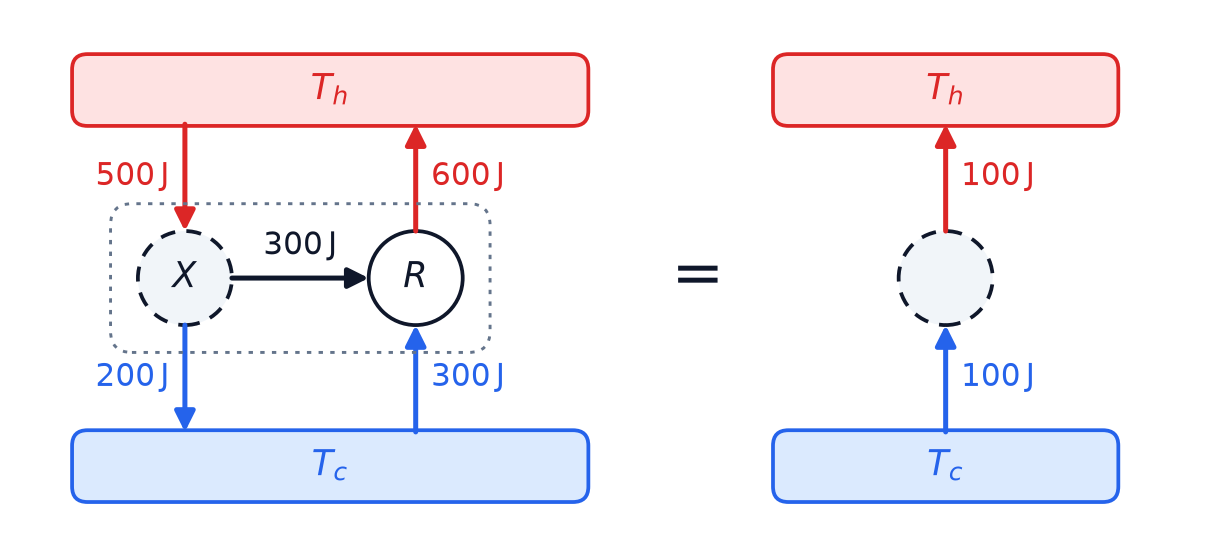
The proof with numbers. The hypothetical engine (dashed) claims efficiency 0.6, and the reversible engine has 0.5 between the same reservoirs. draws from the hot reservoir, dumps into the cold one, and hands its of work to , run backwards as a heat pump. uses it to lift out of the cold reservoir and deliver to the hot one. Read the pair as one machine (dotted outline): no work enters or leaves, and has moved from cold to hot — the Clausius statement’s forbidden machine.
Why reversibility is the step that matters. The proof runs backwards and assumes that, backwards, it consumes exactly the work it used to deliver and moves exactly the heats it used to move — every arrow flipped, every magnitude unchanged. That is what reversible means, and only a reversible engine does it. Run an engine with friction backwards and the friction does not turn round: it still eats work, now on the way in, and the reversed machine is a worse heat pump than the forward one was an engine. That is why the theorem compares every engine with a reversible one, and why reversibility had to be defined first.
Sadi Carnot published this argument in 1824, when heat was believed to be a conserved fluid, caloric, falling from hot to cold through an engine the way water falls through a mill wheel. That theory was wrong — heat is not conserved; part of it becomes the work — yet his conclusion survived intact. Clausius and Kelvin rebuilt the proof around 1850 on energy conservation and the second law, and the version above is theirs. A result that outlived the theory it was born in is the historical face of what the proof shows: it never needed to know what heat is made of.
Putting a number on it
Carnot’s theorem says the reversible efficiency is some universal function of the two temperatures. To find the function we only need to evaluate it once, for any convenient reversible engine — and the ideal gas is convenient.
Take the Carnot cycle: isothermal expansion from to at ; adiabatic expansion to , cooling the gas to ; isothermal compression at to ; adiabatic compression back to the start.
On the hot isotherm , so all the absorbed heat leaves as work:
On the cold isotherm the gas is compressed, so work is done on it, and since again the same amount leaves as heat. Its size is
Now the two adiabats do the essential work. Along an adiabat is constant. The expanding adiabat joins at to at , and the compressing one joins at to at :
Both adiabats connect the same pair of temperatures, so both stretch the volume by the same factor, and dividing one condition by the other gives
Here is the whole cycle as a ledger, in the course’s sign convention — heat into the gas and work done on it both counted positive — with and :
| Stroke | Touches | (into gas) | ||
|---|---|---|---|---|
| isothermal expansion | 0 | |||
| adiabatic expansion | nothing | 0 | ||
| isothermal compression | 0 | |||
| adiabatic compression | nothing | 0 |
Two things to notice. The last column sums to zero, as it must round a closed loop. And the two adiabats’ works are equal and opposite, because each is times the same temperature span: they cancel exactly, and every joule the cycle nets comes from the two isotherms. That is the overshoot in the animation’s middle bar — the adiabatic expansion adds work that the adiabatic compression hands straight back.
The two logarithms are therefore equal, and they cancel:
Two consequences fall straight out. Since always, always: a cyclic engine must reject heat, and the of prediction 1 is not recoverable waste but a structural requirement. And would need or , neither of which is available.
Temperature without a thermometer
Here is a consequence worth pausing on. The ratio for a reversible engine depends on nothing but the two reservoirs, and equals . So that ratio can be used to define temperature.
This is Kelvin’s scale, and its virtue is that it mentions no substance at all: not the expansion of mercury, not the pressure of a dilute gas, nothing that could behave differently in a different material. Every empirical thermometer is a stand-in for this definition.
Since 2019 the SI has pinned the scale down differently, by defining the Boltzmann constant to be exactly , so the triple point of water, , is now a measured value rather than a definition. The scale is the same one; only the way it is anchored has changed.
Running the cycle backwards
Every stroke of a reversible cycle can be reversed — that is what the word means — so the Carnot engine read right to left is a Carnot refrigerator. Work goes in, heat comes out of the cold reservoir, and goes into the hot one. Nothing new needs deriving; the same cancelling logarithms give
Note the exact identity . It is energy conservation and nothing more: everything the machine lifts from the cold side, plus the work it consumed, arrives on the hot side.
These are the coefficients of the Carnot refrigerator. That no other refrigerator can do better is not yet proved — Carnot’s theorem was about engines — and the next section proves it along with a great deal else.
The Clausius inequality
Carnot’s theorem is a statement about engines. The second law is broader than that — it constrains refrigerators, heat leaks, and machines that touch a dozen reservoirs — and Clausius found the form of it that covers all of them at once. It follows from the Kelvin statement in a few steps.
Signed heats. For this section write for heat into the device from a reservoir, positive or negative as it happens: the course’s ordinary sign, applied to each reservoir exchange separately. An engine has and ; a refrigerator has and .
Two reservoirs. Let any device run one cycle between reservoirs at and , exchanging and . Attach a reversible Carnot machine between the same two reservoirs, sized and run in whichever direction makes it return to the cold reservoir exactly what the device took from it, so that the cold reservoir nets nothing: takes in on its cold side. A reversible machine’s heats are in the ratio of the temperatures — that is what the thermodynamic scale says — so , and takes in on its hot side.
Now read the device and together. After one cycle each is back where it started, the cold reservoir is exactly as it was, and the only thing touched is the hot reservoir, which has given up
If that were positive, the pair would be a cycle whose sole result turns one reservoir’s heat into work, and Kelvin forbids it. So it is zero or negative. Dividing by :
When does equality hold? If the device is reversible, run it backwards: every flips sign, so the same argument now gives , and the two together force equality. Conversely, if equality holds, the pair leaves no trace at all — the hot reservoir nets nothing either — so has undone everything the device did, which is exactly what it means for the device to be reversible. Equality for reversible devices; strict inequality for every other one.
What it gives back. For an engine, in the sizes used so far, and , and the inequality reads — which is , Carnot’s bound again. For a refrigerator and , with , and the inequality becomes
a ceiling on every refrigerator, not only the Carnot one evaluated above.
Many reservoirs. A real device meets a whole range of temperatures — a gas heated at constant volume passes through every temperature on the way up. Clausius handled this by giving every exchange its own auxiliary machine.
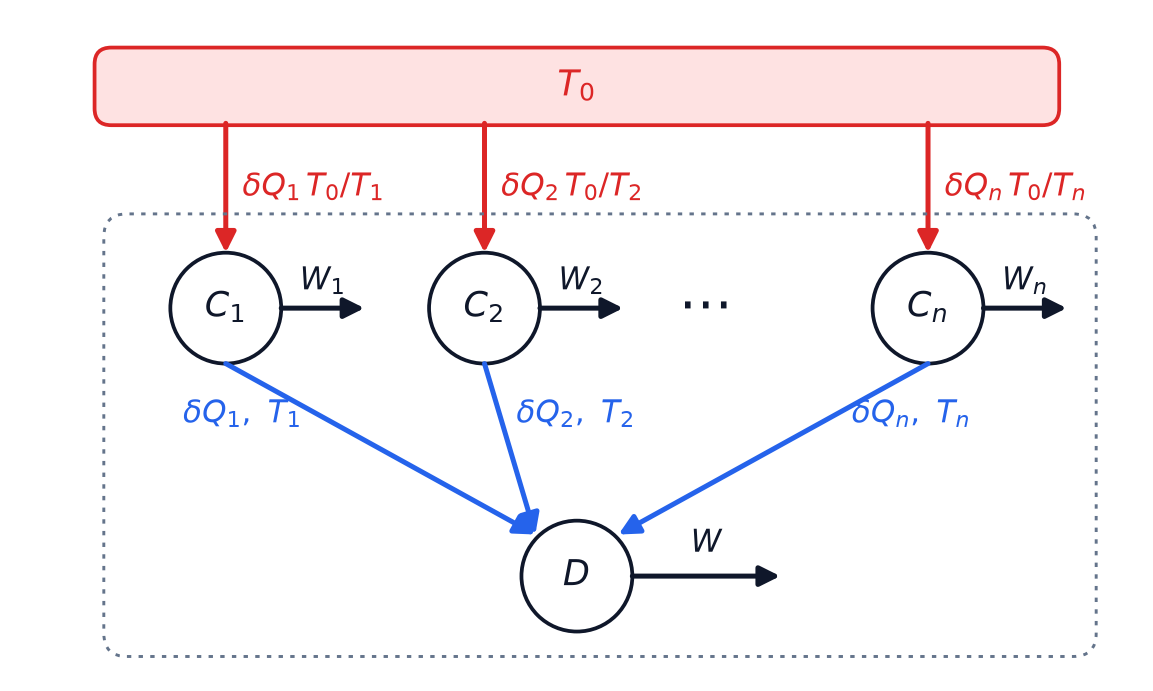
Clausius’s construction. The device goes round a cycle, taking in heat at each of the temperatures it meets on the way. Each of those heats is supplied by its own reversible engine , which runs between a single reference reservoir at and the temperature , drawing from the reference. Everything inside the dotted outline returns to its starting state, and the only thing outside it that it touches is the reservoir at .
Each auxiliary engine supplies the device with exactly the heat it takes in at temperature — negative where the device gives heat out — and, being reversible, draws from the reference reservoir to do so. Over one cycle of everything inside the outline, the only reservoir touched is the one at , which gives up
Kelvin forbids this from being positive, and in the limit of many small exchanges the sum becomes an integral around the cycle.
Note which temperature divides: the reservoir’s, not the device’s. For a cycle of quasistatic strokes, dividing by the gas’s own temperature instead gives zero whether or not the heat crossed a gap on the way in, and proves nothing — the entire content of the inequality lives in the gap between the two temperatures.
Entropy: a new function of state
Apply the inequality to a reversible cycle and it becomes an equality. For a reversible exchange there is no gap between the system and its reservoir, so is simply the system’s own temperature:
Now take two equilibrium states and and any two reversible paths between them, I and II. Out along I and back along II is a reversible cycle, and reversing a path flips the sign of every , so
The integral does not depend on which reversible path is taken, only on its endpoints — which is precisely the condition for it to be the change in a function of state.
The inexact differential has been turned into an exact one by dividing by — is an integrating factor for heat, in the sense the conventions page sets out. This is the payoff module 05 and the mathematics refresher were preparing for, and it has been reached without a single mention of atoms.
The ideal gas. Along a reversible stroke
Divide by , use , and each term integrates on its own:
Two special cases are worth knowing by name. Along an isotherm the change is
, which is the heat absorbed divided by . Along a
reversible adiabat, — no heat, no entropy change — which is why a reversible
adiabat is also called an isentrope. This is the formula thermolab.engines.entropy_change_of_gas
evaluates.
A reservoir. A reservoir stays at its fixed temperature while it exchanges heat, and it is so large that it never leaves equilibrium, so every exchange is reversible from its own side. If it receives heat ,
A body with a constant heat capacity. Warm it reversibly from to , one small step at a time, with :
Now look again at the free expansion of module 06: to at fixed temperature, no heat and no work. No heat crossed, so a naive reading says no entropy change. But is a function of state, and the reversible isotherm between the same two states gives an entropy change of , which is positive. The gas’s entropy rose although nothing flowed in — which is what it looks like when a process produces entropy rather than receiving it.
Entropy produced, and where the lost work goes
Any process, not only cycles. Take a system from state to state by any process at all, exchanging heat with reservoirs, and bring it back along a reversible path. The round trip is a cycle, so the Clausius inequality applies, and the reversible return from to contributes exactly . So
with equality exactly for a reversible process. A system’s entropy can rise by more than the heat it received brings in, never by less. Two consequences follow at once.
For an adiabatic process nothing is received, so . For an ideal gas arriving at the quasistatic adiabat’s final volume, the entropy formula gives a change of , so says — the theorem of the reversibility section, in one line.
For an isolated system nothing is received either, so its entropy can only rise or stay the same. Why it rises to a maximum, and what that maximum picks out, is the business of module 09.
The balance sheet. Now include the reservoirs. Each reservoir’s entropy changes by the heat it receives divided by its temperature, the system’s by its own , and whatever is left over is new.
The heat each reservoir received is the heat the system took from it with the sign flipped, so the inequality above is a statement about this sum.
The refrigerator and its food — prediction 4. A refrigerator holds its interior at by lifting heat out of it, and the kitchen at receives . The interior loses entropy , and that is all the question noticed. The kitchen gains , and the Clausius inequality says this is at least as much:
The second law constrains the total, not any one piece of it. A fall in entropy in one place is always paid for by a larger rise somewhere else — here in the kitchen — and the payment is the electricity.
A heat leak. Let heat conduct straight from a reservoir at to one at through a rod that ends the process exactly as it began. Then
strictly positive whenever : source 1 of the reversibility section, now as a number.
Where the lost work goes. Compare a real engine with a reversible one drawing the same heat from the same hot reservoir. The reversible one delivers ; the real one delivers , in sizes as throughout. The shortfall is
and the bracket is exactly the cycle’s entropy produced.
Apply it to the heat leak. The rod produced , so it threw away
exactly the work a Carnot engine placed across the same gap would have made. Heat that flows downhill without an engine in the way does not merely go unused. It destroys the opportunity it carried.
Verify computationally
The derivation above is a chain of exact statements, so the laboratory’s job is to check that the chain was assembled correctly — and to make the bound something you have tried and failed to break rather than something you were told. Each check below is also a test in the project’s suite.
1. The cycle closes. Each of the four strokes computes its endpoint from its own closed form. Coming back to the starting is four independent formulae agreeing, to within 10-12 of the internal energy.
2. The first law closes around the loop. for every cycle built here, engine and refrigerator alike.
3. The efficiency comes out at . Nothing in the construction puts that number in — the strokes know only volumes and temperatures. Recovering it is the check.
4. Carnot’s theorem, as an experiment.
5. Imperfect contact costs exactly what it produces. Give the engine a gas that sits below the hot reservoir and above the cold one — which is what it takes to make heat flow at a finite rate — and two numbers move together: the efficiency falls, and the entropy produced per cycle, , rises from zero. Every stroke of this engine is quasistatic, so it is also the counterexample prediction 6 was after: as slow as you like, and irreversible all the same, because its heat crosses a finite temperature gap however slowly it moves.
6. A real cycle falls short for a reason, not for lack of care. The idealised petrol engine — two adiabats and two constant-volume heat strokes, every one of them reversible — reaches for compression ratio , to twelve figures, and always less than between its own coldest and hottest states. Ask the laboratory for its Clausius sum and it refuses: its heat strokes happen while the gas’s temperature is changing, so no single reservoir temperature describes either of them. Worked example 5 below explains the shortfall.
7. No adiabatic route beats the quasistatic one. Release the piston against a constant load — any load, lighter than the gas’s pressure so that it expands or heavier so that it is compressed — and compare with the quasistatic adiabat to the same final volume. The loaded route ends hotter every time, as the theorem of the reversibility section demands. This too is a falsification test: one counterexample would mean the code, or the theorem, is wrong.
8. Entropy is a function of state, and the Clausius sum is not. Let a gas expand freely to twice its volume, then push it back along the isotherm in contact with a reservoir at its own temperature.
Transfer the idea
The pattern — a conversion that energy conservation permits but a second, independent law forbids — reaches well past engines.
Power stations. Steam at against a river at gives a Carnot bound of 0.64, from . Real plants reach about 0.40. That is not a 24-point engineering failure: the maximum-power efficiency , derived in the advanced section, lands almost exactly on it, because a plant optimised for output rather than for thermodynamic virtue is solving a different problem.
Why aircraft run their turbines hot. Every gain in has to come from raising , since is the sky and is not negotiable. The history of the jet engine is very largely the history of materials that survive a hotter turbine inlet.
Heat pumps for buildings. A COP of 4 means a kilowatt of electricity delivering four kilowatts of heating, which sounds like a violation and is not. It is the Clausius statement respected: heat moves uphill, but not as the sole result.
Biology. Muscles are not heat engines — a cell is essentially isothermal, so a heat engine inside it would have and could do nothing at all. Life runs on chemical free energy instead, which is why module 10’s potentials matter more to biochemistry than this module does.
Information. Szilard’s engine extracts of work per bit of information about a molecule’s position, and Landauer’s principle charges the same amount to erase the bit. The books balance only when information is included, which is one of the deepest places this law reaches.
The bridge to counting. Module 08 defines entropy completely differently, as — a count of microstates, with no engine anywhere in sight. Try it on the free expansion: doubling the volume doubles the positions open to each of particles, so grows by a factor and — the number this page got from a reversible isotherm and a heat integral. The two definitions agree, up to the additive constant that a counting argument cannot fix and a Clausius integral never needed. The agreement is not a coincidence; it is why the same word is used for both, and why a bound derived from steam engines turns out to govern the mixing of gases and the folding of proteins. It also says what makes heat “low-grade”: heat is energy spread at random over some 1023 molecular coordinates, work is energy in one coordinate — the piston — and herding the first back into the second is overwhelmingly improbable. That is the Kelvin statement, read one level down.
Worked examples
Try each one before opening its solution.
Worked example 1 — checking a claim. A company proposes a geothermal plant that draws heat from underground brine at and rejects it to air at , and advertises an efficiency of . Should you invest?
Solution
Convert first: and . The best any engine can do between these is
The claim exceeds it, so it is impossible however the plant is built. Check it on the balance sheet as well: per drawn from the brine the plant would deliver and reject , so
Negative: the plant would destroy entropy, which is the same verdict in the other language. The margin is narrow — the claim is half a percentage point over the bound — which is exactly why it has to be computed rather than eyeballed. And note the trap: fed Celsius, the same formula gives 0.833, and the claim would look modest.
Worked example 2 — a Carnot cycle, stroke by stroke. A monatomic ideal gas (), with chosen so that , runs a Carnot cycle between and , doubling its volume on the hot isotherm. Fill in the ledger, find the efficiency, and follow the entropy.
Solution
The cold isotherm spans the same volume ratio as the hot one, and each adiabat spans the same , so
the last being the work each adiabat moves, with . With heat into the gas and work done on it both positive:
| Stroke | (J) | (J) | (J) | (J/K) |
|---|---|---|---|---|
| hot isotherm | +346.6 | -346.6 | 0 | +0.6931 |
| adiabatic expansion | 0 | -300.0 | -300.0 | 0 |
| cold isotherm | -207.9 | +207.9 | 0 | -0.6931 |
| adiabatic compression | 0 | +300.0 | +300.0 | 0 |
The adiabats’ is more than the whole cycle nets, and they cancel. The net work done on the gas is , so the engine delivers and
For the entropy: the gas’s column sums to zero, as a function of state must round a loop. The hot reservoir gave up and the cold one received , so
and . A reversible engine is a conduit for entropy: each cycle it carries from the hot reservoir to the cold one and creates none. The heat it must reject is exactly the heat needed to carry that entropy out at — which is how was computed above. That is the rejected heat of prediction 1, seen as a necessity rather than a loss.
Worked example 3 — a heat leak is work thrown away. A furnace wall at leaks of heat through its insulation into a room at . How much entropy is produced, and how much work has been lost?
Solution
The wall and the room act as reservoirs, and the insulation ends as it began, so
The lost work, and the check the other way — a Carnot engine across the same gap, fed the same — agree:
Two-thirds of the leaking heat’s value is gone, though not one joule of energy was destroyed. That is what insulation is really for.
Worked example 4 — a cooling cup of coffee. A cup of coffee — treat it as water, with specific heat — cools from to the room’s . Find the entropy change of the coffee, of the room, and of the two together, and the work that could have been extracted along the way.
Solution
The coffee’s heat capacity is , which is . Its temperature changes, so it is not a reservoir; use the constant-heat-capacity result, which gives the coffee
The room is a reservoir at , and it receives all the heat the coffee gives up:
The coffee’s entropy fell, and by a lot; nothing is wrong, because the room’s rose by more. The second law is about the total, and no part of a system is obliged to gain entropy.
A reversible engine running between the cooling coffee and the room would have turned each slice of heat into work with efficiency :
Multiply the entropy produced by the room’s temperature and the same number comes back,
so the lost-work rule holds even for a hot side whose temperature fell the whole time.
Worked example 5 — the Otto engine. An idealised petrol engine takes in air at , compresses it adiabatically by a factor (air has ), heats it at constant volume to by burning the fuel, expands it adiabatically back to the full volume, and exhausts the heat at constant volume. Find its efficiency, compare it with the Carnot bound between and , and explain the gap — every stroke is reversible.
Solution
Along both adiabats is constant, so each changes the temperature by the same factor:
giving after compression and after expansion. Heat enters only on the ignition stroke and leaves only on the exhaust stroke, both at constant volume, so
where the middle step uses the two adiabats once more:
The Carnot bound between the same extremes is much higher:
Why the gap, when every stroke is reversible? Slice the cycle with many adiabats, close together. Each thin slice is a small cycle that takes in a sliver of heat on the ignition stroke at some temperature , and rejects a sliver on the exhaust stroke at , the temperature the same adiabat reaches at the other volume. A thin slice exchanges heat at essentially two temperatures, so it is a small Carnot engine, and its efficiency is — the same for every slice, which is why the whole engine has that value. But the slice at the bottom of the ignition stroke works between and , and the one at the top between and . No slice spans the full range. The Carnot bound is reached only by an engine that takes in all its heat at the top temperature and rejects all of it at the bottom; the Otto engine takes its heat in on the way up.
The same point, in entropy. Each heat stroke changes the gas’s entropy by the same amount, since and are the same ratio. Dividing each stroke’s heat by that entropy change gives the average temperature at which the heat crossed, on the way in and on the way out:
The Otto engine is a Carnot engine between those two averages. Real petrol engines, with friction, heat leaks and a burn that takes time, reach about 0.3.
Check your understanding
An engine absorbs 1000 J of heat from a furnace each cycle and delivers 400 J of work. What is the status of the other 600 J?
A. It must be dumped into a colder reservoir; no design can recover all of it. B. It is lost to friction and heat leaks, and better engineering could recover most of it. C. It is stored in the working substance and released on a later cycle. D. It was never really absorbed; the 1000 J figure must be a measurement error.
Check your answer
Correct answer: A — It must be dumped into a colder reservoir; no design can recover all of it.
A. Right. Around a cycle dU = 0, so the work delivered is Q_h - Q_c, and the second law forces Q_c > 0 for any cyclic engine. The rejected heat is a structural requirement, not a leak — the best conceivable engine between these reservoirs still rejects Q_c/Q_h = T_c/T_h of what it took in.
B. This is the single most common misreading of the second law. Friction and leaks are real and do cost you, but they are not what the law is about: a perfectly frictionless, perfectly insulated engine with reversible strokes still rejects heat. Set every loss to zero and the bound 1 - T_c/T_h remains.
C. A cycle returns the working substance to exactly its starting state, so its internal energy is the same at the end as at the beginning. There is nowhere for energy to accumulate — that is precisely what makes the bookkeeping W = Q_h - Q_c exact.
D. The heat drawn from the furnace and the work delivered are independently measurable and routinely differ by exactly this kind of factor. Nothing is wrong with the numbers; an efficiency of 0.4 is ordinary.
Two engines run between the same furnace and the same river. One uses steam, the other helium. Which can be made more efficient?
A. Neither — the maximum efficiency is the same, because it depends only on the two temperatures. B. Steam, because its phase change lets it absorb much more heat per kilogram. C. Helium, because a monatomic gas has no internal modes to waste energy in. D. Whichever has the higher heat capacity, since it moves more energy per cycle.
Check your answer
Correct answer: A — Neither — the maximum efficiency is the same, because it depends only on the two temperatures.
A. Correct, and this is the surprising half of Carnot’s theorem. The proof never opens either engine: it uses only that one produces work from two reservoirs and that the other can be reversed. Since the working substance never enters the argument, it cannot appear in the answer.
B. Steam really does carry more heat per kilogram, and that matters enormously for the size and cost of a plant. But efficiency is a ratio of work to heat absorbed, and the extra heat appears in both the numerator and the denominator. The ceiling does not move.
C. Energy in rotational or vibrational modes is not wasted — it is returned when the gas is compressed again, since the cycle closes. Work through the Carnot derivation and watch gamma cancel: the efficiency comes out at 1 - T_c/T_h for every f.
D. More energy per cycle means a more powerful engine, not a more efficient one. These are different questions, and conflating them is worth guarding against — power and efficiency are traded against each other in every real design.
A refrigerator lowers the entropy of the food inside it. Does this violate the second law?
A. No — the entropy dumped into the kitchen exceeds the entropy removed from the interior. B. Yes, but only slightly, and real refrigerators are allowed a small violation. C. No, because entropy does not apply to objects as ordinary as food. D. Yes, which is why refrigerators require a continuous supply of electricity.
Check your answer
Correct answer: A — No — the entropy dumped into the kitchen exceeds the entropy removed from the interior.
A. Exactly. The second law constrains the total, not any one piece of it. The fridge rejects Q_c + W into the kitchen at the higher temperature, and the accounting comes out non-negative overall, with equality only for a reversible machine.
B. The second law admits no violations, small or otherwise. There is nothing to excuse here: the total entropy genuinely increases, because the heat rejected to the warm kitchen carries more entropy than the heat removed from the cold interior.
C. Entropy is defined for any system in equilibrium, food very much included. The resolution is not that the law fails to apply but that the boundary was drawn too small — look at the fridge plus the kitchen.
D. The electricity is needed, and the intuition is pointing somewhere real, but the conclusion is backwards. The work input is what allows the machine to obey the Clausius statement, since moving heat from cold to hot is forbidden only as a sole result. Paying for it is what makes it legal.
A power station’s boiler is at 811 K and its condenser at 311 K. Compute the maximum possible efficiency, as a decimal fraction between 0 and 1.
Check your answer
Correct answer: 0.6165 (± 0.005)
eta_max = 1 - T_c/T_h = 1 - 311/811 = 0.6165. If you got 0.3835 you computed T_c/T_h and forgot to subtract it from 1. If you got something near 0.93 you used Celsius: the ratio of temperatures is only meaningful on an absolute scale, and this is the most expensive single mistake available in this module. The plant actually achieves about 0.40, and that gap is mostly deliberate — see the maximum-power efficiency.
Which of these machines, if built, would violate the Kelvin statement of the second law?
A. A ship that draws heat from the ocean and converts it entirely to propulsion, cycle after cycle, changing nothing else. B. A gas expanding isothermally, absorbing heat and doing an equal amount of work. C. A refrigerator moving heat from its cold interior to the warmer kitchen. D. An engine achieving an efficiency of 0.35 between reservoirs at 600 K and 300 K.
Check your answer
Correct answer: A — A ship that draws heat from the ocean and converts it entirely to propulsion, cycle after cycle, changing nothing else.
A. Correct: this is a cyclic machine whose sole result is heat drawn from a single reservoir appearing as work. Both qualifiers matter — it repeats, and nothing else anywhere is left changed. Note that energy is perfectly conserved, which is why the first law has nothing to say about it.
B. This converts heat entirely to work at 100%, and it is entirely legal — because it is not cyclic. The gas ends up larger and lower in pressure, so the trick cannot be repeated without first paying to compress it back.
C. Legal, and sitting in your kitchen. The Clausius statement forbids this only as a sole result; a refrigerator also consumes electricity, so something else is left changed.
D. Perfectly legal: 0.35 sits below the bound of 1 - 300/600 = 0.50. The second law sets a ceiling, and this engine is under it.
A heat pump warms a house at 295 K using outside air at 273 K. Compute its maximum possible coefficient of performance (heat delivered per unit work input).
Check your answer
Correct answer: 13.41 (± 0.2)
COP_pump = T_h/(T_h - T_c) = 295/22 = 13.41. If you got 12.41 you computed the refrigerator’s coefficient T_c/(T_h - T_c) = 273/22, which differs by exactly 1 — the work input also arrives as heat on the hot side. A value far above 1 is not an error: nothing is being converted here, energy is being moved, and moving it costs less than the amount moved.
Why can the ratio of heats exchanged by a reversible engine be used to define a temperature scale?
A. Because Carnot’s theorem makes that ratio the same for every reversible engine between the same two reservoirs, whatever it is made of. B. Because heat is easier to measure accurately than temperature. C. Because the ideal gas law already relates pressure and temperature linearly. D. Because entropy is defined as heat divided by temperature.
Check your answer
Correct answer: A — Because Carnot’s theorem makes that ratio the same for every reversible engine between the same two reservoirs, whatever it is made of.
A. Exactly. A definition must not depend on the apparatus used to apply it, and this ratio provably does not. Fixing one reference point then fixes the whole scale, and the result refers to no material at all — which is what “absolute” means here.
B. It is generally the other way round, and in any case a reversible engine takes infinitely long per cycle and cannot be built. The value of the definition is conceptual: it says what temperature is, independently of any thermometer.
C. That gives the ideal-gas scale, which is a perfectly good empirical thermometer but depends on a substance behaving ideally. The point of the thermodynamic definition is to need no substance whatever.
D. This reverses the logic. The reversible heat ratio comes first and defines the temperature scale; entropy is then constructed from delta-Q over that T. Using entropy to define T here would be circular.
Before reading the section on entropy produced: an engine between reservoirs at 600 K and 300 K has imperfect heat exchangers, so its gas sits at 560 K while absorbing and 340 K while rejecting. Every stroke it performs is internally reversible. Predict (a) its efficiency, (b) whether the loop integral of delta-Q over the reservoir temperature is zero or negative, and (c) where the work it fails to deliver has gone.
Check your answer
(a) The efficiency is set by the temperatures the gas works between, not the reservoirs’: 1 - 340/560 = 0.393, against a Carnot bound of 0.500. (b) The loop integral is strictly negative, -0.357 J/K per 1000 J absorbed, because the denominators are the reservoir temperatures 600 and 300 rather than 560 and 340. Dividing by the gas’s own temperature instead gives exactly zero for this cycle of quasistatic strokes and proves nothing — the entire inequality lives in the gap between the two temperatures. The entropy produced per cycle is therefore S_gen = +0.357 J/K. (c) The lost work is 500 - 393 = 107 J, and it equals T_c times the entropy produced: 300 * 0.357 = 107 J. Lost work and produced entropy are one quantity seen from two sides. If you predicted the efficiency from the reservoir temperatures, note what the engine can actually “see”: it only ever touches its own gas.
In two or three sentences, explain why a cyclic heat engine must reject heat to a cold reservoir, in a way that does not appeal to friction, leaks, or imperfect engineering.
Check your answer
A good answer runs through the cycle condition: closing the loop forces dU = 0, so the work delivered is exactly Q_h - Q_c, and the Kelvin statement forbids Q_c = 0 for a cyclic machine. Stronger answers add the quantitative version — Q_c/Q_h = T_c/T_h for a reversible engine, which is positive because absolute temperatures are — and note that this is why the rejected heat is structural rather than wasteful. Answers that say “some energy is always lost” have not distinguished the second law from sloppy engineering and should be pushed: ask them what a perfect, frictionless engine does.
Each of these processes is carried out extremely slowly. Which one can be made reversible?
A. A gas compressed by a frictionless piston while in contact with a reservoir at the gas’s own temperature. B. A block pushed very slowly across a rough table, its friction heating the table. C. Heat leaking very slowly through a thick wall from a room at 300 K to outside air at 270 K. D. A gas leaking very slowly through a pinhole into an evacuated chamber.
Check your answer
Correct answer: A — A gas compressed by a frictionless piston while in contact with a reservoir at the gas’s own temperature.
A. Right. It is quasistatic, frictionless, and the heat it gives up crosses no temperature difference, so every condition holds: run it backwards and gas and reservoir both return exactly to where they were.
B. Slowness does not remove friction. However gently the block moves, the work spent against friction ends up as heat in the table, and getting it back as work with no other change would violate the Kelvin statement. Slow is necessary for reversibility, never sufficient.
C. The leak is slow, but the heat still crosses a 30 K gap, and slowness does not shrink the gap. Sending that heat back from 270 K to 300 K with nothing else changed is exactly what the Clausius statement forbids.
D. This is a free expansion done gradually: nothing pushes back on the gas, no work is extracted, and the gas’s entropy rises by N k_B ln(V_final/V_initial) with nothing received to account for it. The rate of leaking changes none of that.
1000 J of heat conducts through a metal bar from a reservoir at 800 K to a reservoir at 400 K. The bar ends in the same state it began. How much entropy is produced, in J/K?
Check your answer
Correct answer: 1.25 (± 0.02)
S_gen = 1000/400 - 1000/800 = 2.50 - 1.25 = 1.25 J/K: the cold reservoir gains more entropy than the hot one loses, because the same heat is divided by a smaller temperature. If you got -1.25 you swapped the signs; entropy produced is never negative. Multiply by T_c and you get the work thrown away, 400 * 1.25 = 500 J - exactly what a Carnot engine across the same gap would have delivered from the same 1000 J.
An idealised petrol (Otto) engine has no friction and every one of its four strokes is reversible, yet its efficiency is well below 1 - T_min/T_max, where T_min and T_max are the coldest and hottest temperatures its gas reaches. Why?
A. It takes in heat while its gas is still heating up, below T_max, and rejects it while cooling down, above T_min. B. Some of the work is always lost to friction in the pistons. C. Air is not an ideal gas, so the Carnot formula does not apply to it. D. Its compression ratio is too low; at a high enough ratio it would reach the Carnot bound.
Check your answer
Correct answer: A — It takes in heat while its gas is still heating up, below T_max, and rejects it while cooling down, above T_min.
A. Correct. The Carnot bound is reached only if all the heat enters at the top temperature and all of it leaves at the bottom. Slice the Otto cycle with adiabats and every slice is a small Carnot engine working across a narrower span than T_max to T_min, which is why the whole engine lands at 1 - r^(1-gamma).
B. The idealised engine has no friction by construction, and it still falls short. Friction lowers real engines further, but it is not what separates the ideal Otto cycle from the Carnot bound.
C. The Carnot bound applies to every working substance - that is the point of Carnot’s theorem. In the idealised model air is treated as an ideal gas anyway, and the shortfall is still there.
D. Raising the compression ratio raises the efficiency, but it also raises the temperature at which heat starts to enter, and the heat still enters over a range of temperatures. At any finite ratio the engine stays below the bound between its own extremes.
1.0e23 particles of an ideal gas double their volume at a constant temperature of 300 K. Take k_B = 1.381e-23 J/K. What is the gas’s entropy change, in J/K?
Check your answer
Correct answer: 0.957 (± 0.01)
Delta S = N k_B ln 2 = (1.0e23)(1.381e-23)(0.6931) = 0.957 J/K. The temperature does not enter, because the heat absorbed is N k_B T ln 2 and it is divided by the same T. The answer is identical if the gas doubles its volume by free expansion into a vacuum, where no heat is absorbed at all: entropy is a function of state, and the reversible isotherm is only the instrument for computing it.
A cup of hot coffee cools on a desk until it reaches room temperature, and its entropy decreases. Which statement is correct?
A. The room’s entropy rises by more than the coffee’s falls, so the total entropy increases. B. The second law is violated, but only briefly, until the coffee reaches room temperature. C. The coffee’s entropy cannot really decrease; it only appears to, because heat is leaving it. D. The total entropy is unchanged, because the heat the coffee loses equals the heat the room gains.
Check your answer
Correct answer: A — The room’s entropy rises by more than the coffee’s falls, so the total entropy increases.
A. Right. The room receives the coffee’s heat at the lower temperature, so the same heat brings it more entropy than the coffee lost. The second law constrains the total; any one part may lose entropy as long as the rest gains more.
B. The second law admits no temporary violations. Nothing needs excusing here: the coffee’s entropy genuinely falls, and the room’s rises by more at every instant of the cooling.
C. It really decreases. For a body of heat capacity C cooling from T_1 to T_2 the change is C ln(T_2/T_1), which is negative. The second law never said every part must gain entropy.
D. Equal heats are not equal entropies. Entropy change is heat divided by temperature, and the room receives the heat at a lower temperature than the coffee gave it up, so the room’s gain is larger. The difference is the entropy produced.
Exam-style problems for this module — the ones worth doing with a pen — are collected in the problem set.
Explain it in your own words
Answer in a few sentences each. No number will save you here.
A student says: “The second law says engines are inefficient because of friction and heat losses.” Explain precisely what is wrong with this, and give a version that is correct.
Explain to someone who knows the first law why the ocean-powered ship fails, without using the word entropy.
Why can the maximum efficiency not depend on what the engine is made of? Point to the step in Carnot’s argument that makes this inevitable.
Your refrigerator lowers the entropy of the food inside it. Say exactly why this is not a violation, and where the compensating increase happens.
A colleague proposes doubling a power plant’s efficiency by improving its turbine blades. Under what circumstances could they be right, and what would you need to measure to find out?
Name four ways a process can fail to be reversible. For one of them, show step by step that undoing it without trace would violate the Kelvin or the Clausius statement.
A free expansion exchanges no heat, yet the gas’s entropy rises. Explain why defining entropy requires a reversible path, and why it can nevertheless be assigned to the end of a violently irreversible process.
Advanced: power, regenerators, and where the temperature scale comes from
Endoreversible engines. The engine with temperature gaps is worth a second look. Let heat flow at a rate proportional to the temperature difference, and optimise the power rather than the efficiency; the optimum sits at
the Curzon–Ahlborn efficiency. It is not a bound — it is the answer to a different question — but its agreement with real plants is striking, and it makes a point worth carrying: the Carnot bound is attained only by an engine that takes infinitely long per cycle and therefore delivers zero power. Every real design trades efficiency for power on purpose.
Regenerators: reaching Carnot without Carnot’s shape. A Stirling engine runs two isotherms joined by two constant-volume strokes. Between the isotherms the gas has to be cooled from to , and later warmed back; done against the reservoirs, that would push heat across large temperature gaps, which is irreversible and costs efficiency. A regenerator avoids it: a matrix of fine wire that the gas passes through on its way down, leaving its heat in layers graded from at one end to at the other, and picks back up on its way up, each layer returning heat at the temperature it was deposited. For an ideal gas the two constant-volume strokes move the same heat in opposite directions, so a perfect regenerator balances exactly, and the only heat crossing to the outside is on the two isotherms, at and . The engine is then reversible, exchanges heat externally with two reservoirs only, and reaches on constant-volume strokes. That is why the core said the Carnot shape is forced only for an engine whose substance exchanges heat with nothing but the reservoirs: the regenerator is a third thing to exchange with. The Clausius inequality covers it without modification; the four-stroke picture of this module’s laboratory does not.
Why the heat ratio must factorise. The core defined thermodynamic temperature by the reversible heat ratio and used the ideal gas to fix its form. There is an argument that needs no gas. Carnot’s theorem says the heat ratio of a reversible engine between two reservoirs is a universal function of them alone, , where is any empirical temperature. Stack two reversible engines: one between and , and a second that takes the heat the first rejects at and works on down to . The pair is a reversible engine between and that leaves the middle reservoir unchanged, so
for every . Fix at a reference value and the right-hand side splits into a function of times a function of , so for a single increasing function . That is the thermodynamic temperature, up to a constant factor; the ideal-gas calculation only confirmed that is proportional to the gas thermometer’s .